
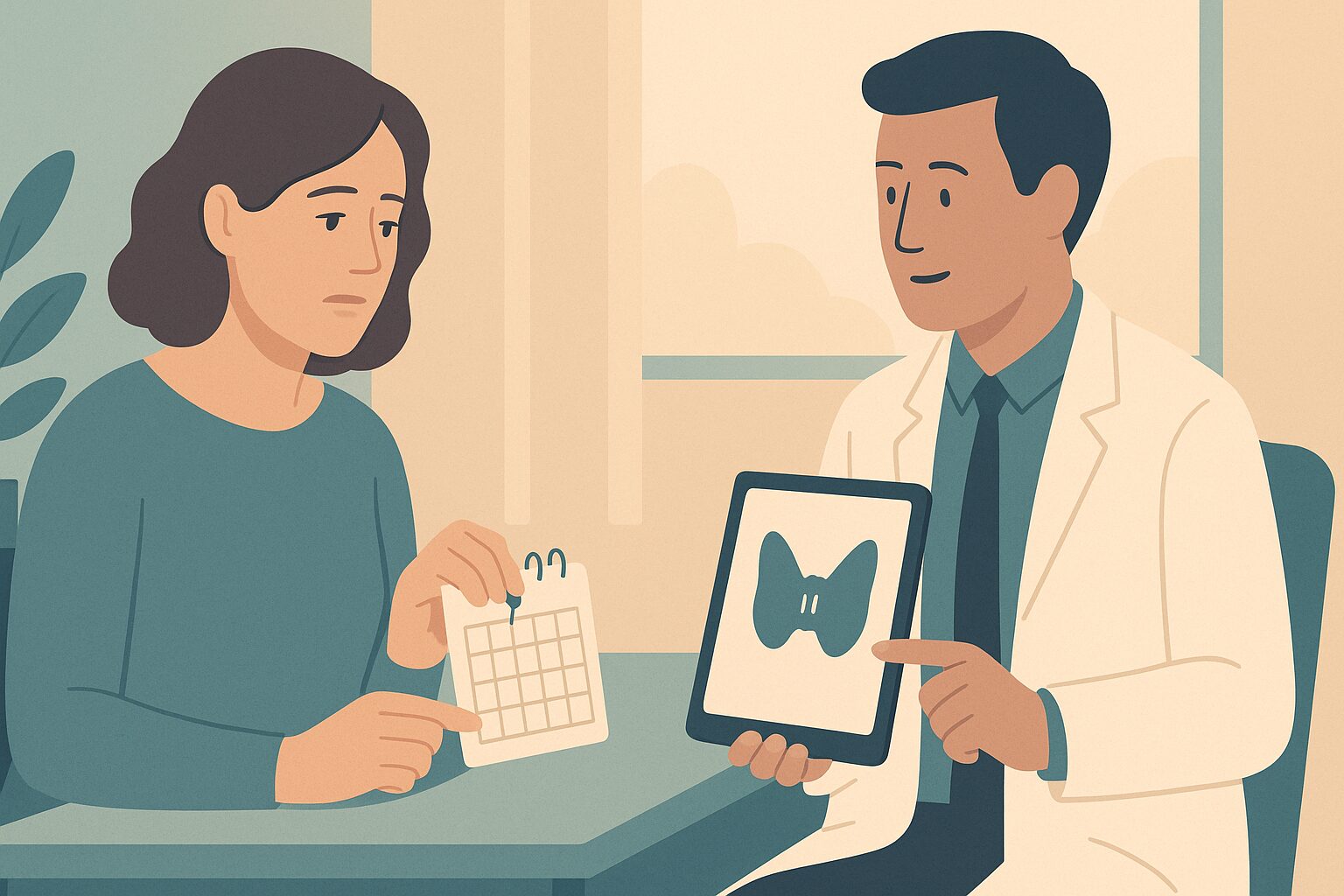
A hair transplant is possible with thyroid disease, but only once thyroid function has been stable on treatment for at least six to twelve months and the shedding it caused has settled. Thyroid-related hair loss is diffuse and usually reversible, so operating before that point spends donor hair on a problem that medication would have solved.
The harder question is whether the loss is thyroid-related at all. Many patients have thyroid disease and pattern hair loss at the same time, and only the second is a surgical problem.
Thyroid disorders are common, more so in women, and hair change is often the symptom that sends people to a doctor in the first place. Patients with an underactive or overactive thyroid who then look into a hair transplant are frequently given a flat no, or, worse, an unqualified yes. Neither is right. This guide from HairX Clinics explains how thyroid disease affects hair, why timing matters more than diagnosis, and how a surgeon separates thyroid shedding from the pattern loss a transplant can actually treat.
How does thyroid disease affect hair?
Thyroid hormone sets the pace of cell turnover across the body, and hair follicles are among the fastest-cycling tissues there are. Both too little hormone and too much disturb the cycle.
| Underactive (hypothyroidism) | Overactive (hyperthyroidism) | |
|---|---|---|
| Hair texture | Dry, coarse, brittle | Fine, soft, sometimes greasy |
| Pattern of loss | Diffuse thinning over the whole scalp; often outer third of eyebrows too | Diffuse thinning, often with faster shedding |
| Mechanism | More follicles pushed into the resting phase; slower regrowth | Shortened growth phase; increased shedding |
| Reversible? | Usually, once hormone levels are corrected, over 6 to 12 months | Usually, once levels are corrected |
| Complication | Treatment itself can trigger a temporary shed in the first months | Some antithyroid drugs can cause shedding |
Two features of that table matter for surgery. Thyroid loss is diffuse, affecting the sides and back as well as the top, and it is largely reversible. A transplant is designed for the opposite situation: permanent loss in a pattern, with a spared donor zone at the back and sides. Our article on what actually works for hair loss explains why matching the treatment to the cause comes first.
Why does a transplant have to wait?
Three reasons, and the third is the one most patients have not been told.
- The loss may reverse on its own. Operating during active thyroid shedding means transplanting into hair that will largely come back once treatment takes effect. Grafts spent there are grafts not available later for real pattern loss.
- The donor area is not reliable. Diffuse shedding thins the back and sides too. A surgeon measuring donor density during an active shed will underestimate the supply, or, if grafts are taken, harvest follicles that are temporarily resting and may not survive transfer well.
- Surgery can provoke shedding. Any transplant can trigger a temporary shed of native hair around the recipient area, described in our guide on shock loss. In a scalp already shedding from thyroid disturbance, that effect can be larger and slower to recover.
Put together, the counter-intuitive truth is that the patient who feels most urgently in need of a transplant, the one shedding visibly every day, is the patient least likely to benefit from one at that moment. Stabilising the thyroid does more for that person’s hair than any surgeon can.
How long is long enough?
Surgeons generally look for two things: thyroid function tests within the normal range on a stable dose of medication, and a period of stability long enough for the hair cycle to have caught up. Because a resting follicle takes roughly three months to shed and several more to regrow visibly, six months of stable function is usually the minimum, and twelve is more comfortable. During that time, photographs taken every two to three months show whether the diffuse thinning is recovering, which is the real evidence a surgeon wants to see.
If, after a year of good control, a pattern of loss remains on the top of the scalp while the sides and back have recovered, that residual pattern is likely to be androgenetic, and it can be assessed for surgery in the ordinary way.
Thyroid loss or pattern loss: how do you tell?
Many patients have both, and untangling them is the core of the consultation. The signs a surgeon looks for:
- Distribution. Thyroid shedding affects the whole scalp evenly. Pattern loss spares the back and sides and, in women, typically widens the parting while keeping the frontal hairline.
- Miniaturisation. Under magnification, pattern loss shows a mix of thick and progressively finer hairs in the affected zone. Thyroid shedding shows fewer hairs, but those present are of similar calibre.
- Timing. Shedding that began within a few months of a thyroid diagnosis, a dose change or a period of poor control points to the thyroid. Thinning that predates it, or that continues after a year of good control, points elsewhere.
- Eyebrows and body hair. Loss of the outer third of the eyebrows and thinning of body hair are characteristic of an underactive thyroid and are not features of pattern loss.
- Family history. Pattern loss usually has relatives.
For women in particular, the overlap between thyroid disease, iron deficiency and female pattern loss is common enough that a full blood workup is often part of the assessment. Our guide on hair transplantation for women explains why the approach differs.
What can a patient with stable thyroid disease expect?
Once function has been stable for long enough and a permanent pattern has been identified, a transplant proceeds much as it would for anyone else, with a few adjustments. The clinic will want recent thyroid function results and a list of medication. Thyroid tablets are taken as normal on the day. Untreated or unstable hyperthyroidism can raise heart rate and blood pressure and interacts with the adrenaline in local anaesthetic, so the doctor responsible for the anaesthetic should know the history. Healing is normal in well-controlled patients.
Growth expectations are the same as for other patients, with one caveat: if thyroid control slips in the year after surgery, the native hair around the grafts can shed again. Keeping the thyroid stable is part of protecting the result.
When would HairX decline to operate?
We would decline, or ask a patient to come back later, when thyroid disease is newly diagnosed or not yet controlled; when shedding is still active or the sides and back are still thin; when the loss is diffuse with no identifiable pattern, whatever the thyroid results say, because that needs a dermatological diagnosis rather than a surgical one; and when hyperthyroidism is untreated, because of the anaesthetic risk. Each of those is a not yet, with a clear path back.
Will my hair grow back once my thyroid is treated?
In most cases, substantially, over six to twelve months. Recovery is often slower than patients hope and may be incomplete if pattern loss is also present, which is why the assessment separates the two.
My thyroid tablets seem to be making my hair worse. Is that possible?
Yes, temporarily. Starting or changing levothyroxine can trigger a shed in the first few months as the hair cycle resets. It usually settles. Do not stop medication without speaking to your doctor.
Do I need to stop thyroid medication before a transplant?
No. It is taken as normal. The clinic needs to know the dose and see recent results, and the anaesthetic doctor should be told if you have ever been hyperthyroid.
Can Hashimoto’s or Graves’ disease affect a transplant differently?
Both are autoimmune, and autoimmune thyroid disease occasionally coexists with alopecia areata, which is a separate condition that a transplant cannot treat. A surgeon will check for patches of complete loss before planning surgery.
How soon after stabilising can I book?
Book a consultation whenever you like; it is the surgery that waits. Most surgeons want six to twelve months of stable function and visible recovery of the diffuse thinning before operating.