
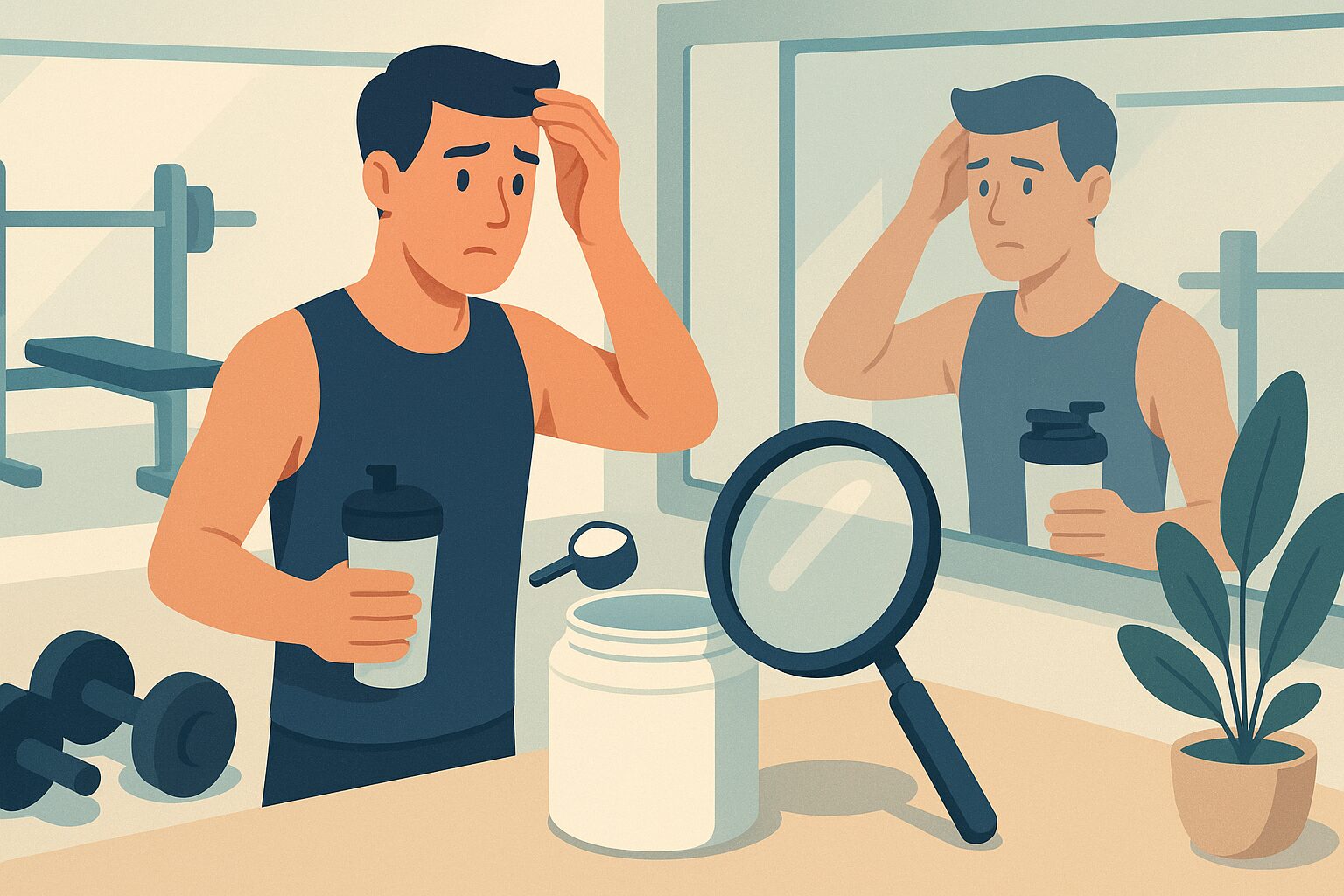
There is no study showing that creatine causes hair loss. The concern traces back to a single small trial in rugby players that reported a rise in DHT after creatine loading — it measured a hormone, not hair, and has not been reliably replicated since.
The honest position sits between the two loud ones: creatine cannot start hair loss in someone without the genetic sensitivity, but in someone who has it, any influence on DHT would nudge a clock that was already running.
This question arrives at HairX Clinics almost exclusively from men in their twenties who train, who noticed their hairline while taking creatine, and who now want to know whether to throw the tub away. It deserves a careful answer rather than a reassuring one, because the mistake most people make here is not about creatine at all — it is about what they conclude when they stop taking it.
Where did the claim come from?
From one study, published in 2009, in a group of college-level rugby players. Participants took creatine through a loading phase and then a maintenance phase, and the researchers measured testosterone and dihydrotestosterone. Total testosterone did not change meaningfully; DHT rose.
Three things about that study matter and are usually left out. It was small. It measured blood hormone levels and never assessed anyone’s hair, at any point. And the DHT values, even after the rise, remained within the normal reference range.
Subsequent work has not consistently reproduced the DHT finding, and no trial has since linked creatine supplementation to hair loss as an outcome. So the chain of reasoning that circulates online — creatine raises DHT, DHT causes baldness, therefore creatine causes baldness — has a measured first link, a well-established second link, and no evidence at all for the conclusion.
Why does DHT matter in the first place?
Androgenetic hair loss happens when follicles that are genetically sensitive to DHT are exposed to it over years. Each cycle, the affected follicle produces a slightly finer, shorter hair, until it produces something barely visible.
The critical word is sensitive. DHT circulates in everyone. Men who never lose a hair have it; men who are bald by thirty have it. What separates them is not how much DHT they have but how their follicles respond to it — which is inherited, and which is why the pattern runs in families and follows a predictable shape. Our guide to the Norwood scale maps that shape stage by stage.
This is why the honest answer is conditional. If you did not inherit the sensitivity, a modest shift in DHT would do nothing to your hair. If you did, you were going to lose hair with or without the supplement.
| Claim | What the evidence supports |
|---|---|
| Creatine raises DHT | One small study found this; replication has been inconsistent |
| Creatine causes hair loss | No study has tested or shown this |
| DHT drives pattern hair loss | Well established, and the basis of existing drug treatment |
| Stopping creatine regrows hair | No evidence; reported cases are confounded by timing |
| Creatine is unsafe for the kidneys | Not supported in healthy adults at standard doses |
Why do so many people blame it anyway?
Because of when people start taking it. Creatine use clusters in men aged eighteen to thirty — which is precisely the window in which androgenetic hair loss most often becomes visible. Two things that begin around the same time feel connected.
There is a second confounder that gets almost no attention. People who take creatine are often also in a training phase involving an aggressive cut, a large calorie deficit, or rapid weight change. That is a genuine trigger for temporary shedding, arriving two to three months after the deficit — and it is easily mistaken for the supplement doing something.
What should you actually do?
- Do not use stopping creatine as a test. Hair changes lag by months, so whatever you observe afterwards will not be attributable to the change you made.
- Photograph it properly. Same position, same lighting, monthly. This settles arguments that no amount of mirror-checking will.
- Look at the back and sides. The single most informative observation, and it takes a mirror and thirty seconds.
- Consider the deficit before the supplement. If you cut hard three months ago, that is a far likelier explanation.
- Get assessed if the pattern is localised. Temple recession or crown thinning at twenty-five is worth acting on early, when treatment preserves rather than rescues.
If assessment does point to pattern hair loss, the decision in front of you is about medication and timing, not supplements. Both of the treatments with meaningful evidence behind them are covered in our guide to finasteride and our guide to minoxidil, and the wider picture of what works and what does not is in hair loss treatment.
And for the answer that nobody asks for: giving up creatine will not preserve your hairline, and keeping it will not cost you one. That decision can be made on training grounds alone.
Should I stop creatine if my hair is already thinning?
There is no evidence that stopping changes the course of pattern hair loss. If thinning has begun, the useful action is a proper assessment and a decision about treatment, not removing a supplement that has not been shown to be involved.
Do protein powders or mass gainers cause hair loss?
No evidence supports this either. Where shedding coincides with a change in diet, the likelier driver is the calorie deficit or a restrictive eating pattern rather than the supplement itself.
What about anabolic steroids?
That is a different question with a different answer. Androgens taken at supraphysiological doses can accelerate androgenetic hair loss substantially in genetically susceptible men, and the acceleration is often not reversible on stopping. Creatine is not an androgen and does not belong in the same category.
Does training itself cause hair loss?
No. Exercise is not a risk factor. Extreme training combined with severe restriction can trigger temporary shedding through the same route as any physiological stress, but training at a sustainable level with adequate intake does not.
I am 24 and my hairline is receding. Is it too early to treat?
Early is when treatment is most useful, because preserving existing hair is more achievable than recovering hair that has already gone. It is also too early for surgery — a pattern that has not stabilised is a reason to wait on a transplant, not to rush one.