
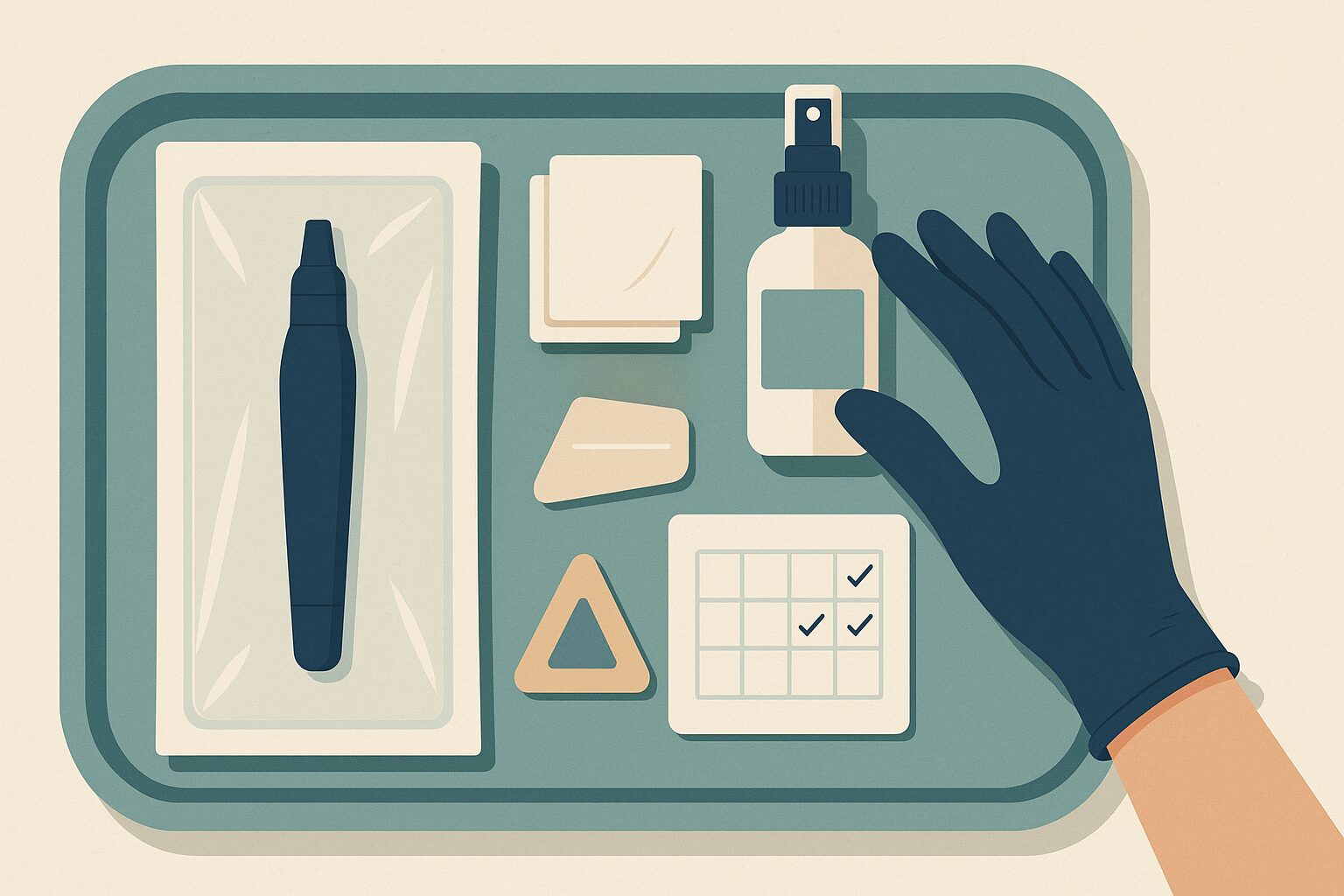
Microneedling has reasonable evidence as an add-on to topical treatment, not as a standalone one. The controlled injury triggers a wound-healing response around the follicle, but it cannot revive a follicle that has already gone.
The part the tutorials skip: rolling opens the skin barrier, so anything applied to a freshly needled scalp is absorbed far more than normal. Applying minoxidil straight after a session is the single most common way people turn a local treatment into a systemic dose.
Patients arrive at HairX Clinics having watched a dozen videos on needle length and none on timing. The length debate is largely noise. Sterility, interval and what goes on the scalp afterwards are what separate a useful routine from an expensive way to irritate your head. Here is how each of those actually works.
What does the needle actually do?
Nothing is being injected and nothing is being removed. The device makes hundreds of tiny punctures in the upper layers of skin. The body reads these as injury and starts a repair cascade: local growth factors, new small blood vessels, a period of raised cellular activity in the tissue around each follicle.
Two things follow from that. First, the effect is indirect, which is why it is consistently described as supportive rather than primary. Second, it needs living follicles nearby to support. A scalp that is smooth and shiny with no visible vellus hair has nothing left for the healing response to act on, and rolling it produces irritation and no growth.
Does needle length matter as much as people claim?
Less than the arguments suggest, and it cuts both ways. Longer needles reach deeper tissue but hurt more, bleed more, take longer to heal and raise the interval you can safely keep. Shorter needles are gentler and allow more frequent sessions. Neither is universally correct, and the useful framing is total stimulation over months, not depth in a single pass.
| Variable | What people obsess over | What actually decides the outcome |
|---|---|---|
| Needle length | Finding the one correct number | Matching length to how often you can realistically heal |
| Pressure | Pressing harder for better results | Even coverage without dragging or tearing |
| Frequency | More sessions, faster results | Full healing between sessions; scarring risk if rushed |
| Device hygiene | Rarely discussed at all | Infection and folliculitis risk, the main real-world harm |
| What follows the session | Applying the strongest thing available | Absorption is elevated, so this is where doses go wrong |
Why is what comes afterwards the real risk?
Intact skin is a barrier, and topical treatments are dosed on the assumption that the barrier is working. Needling temporarily removes that assumption. The same volume of solution on a needled scalp does not behave like the same volume on an unbroken one.
With minoxidil this matters more than with anything else on a bathroom shelf, because its known systemic effects — palpitations, lightheadedness, fluid retention, swelling around the eyes — are dose-related. People who develop those symptoms after starting a rolling routine often assume the product suddenly stopped agreeing with them. The product did not change; the amount reaching the bloodstream did. The background on how the drug behaves normally is in our guide to minoxidil and what to expect.
What goes wrong in practice?
Almost every genuine complication we see traces back to the device rather than the technique.
- Reused rollers. Needles blunt with use, and a blunt needle tears rather than punctures. Tearing is what causes scarring.
- Inadequate disinfection. The scalp is not a sterile surface and the punctures are an open route inwards. Folliculitis is common and avoidable.
- Sessions too close together. Repeated injury to tissue that has not repaired produces inflammation, not growth.
- Rolling over active disease. Any inflamed, scaly or pustular scalp condition should be treated first, not needled. Several of these are covered in our guide to what actually works for hair loss.
- Rolling a recent transplant. Transplanted grafts and healing donor skin are off limits for months, and the timing is the surgeon\u2019s call.
How long before you can judge it?
Six months minimum, twelve for a fair verdict. Microneedling works on follicles that then have to grow hair at their own pace, and no amount of enthusiasm shortens a growth cycle. If you cannot commit to a routine for a year, the honest thing is to put the money into something you will actually sustain.
Judge it the way you would judge any hair treatment: photographs from a fixed angle in fixed light, monthly, rather than daily impressions in the mirror. The same discipline we recommend for reading results month by month applies here, and for the same reason — slow change is invisible to the eye that sees it every day.
Is a dermapen better than a roller?
A motorised pen punctures vertically rather than dragging, which reduces tearing, and single-use tips solve the hygiene problem. Whether that justifies the cost depends on how reliably you would sterilise a roller.
Can microneedling regrow a completely bald area?
No. It amplifies activity around follicles that still exist. Where the follicle is gone, there is nothing for the healing response to stimulate.
Should there be bleeding?
Pinpoint spotting can happen, but bleeding is not the target and more is not better. Anything beyond light spotting means too much pressure or too long a needle for that area.
Can I do it after a hair transplant?
Not in the early months, and not on the grafted area without your surgeon\u2019s approval. Healing skin and settling grafts are the last thing that should be punctured.
Does it work for alopecia areata?
That is a different condition with an immune mechanism and a different treatment path. Needling an active patch is not appropriate and should be discussed with a dermatologist first.