
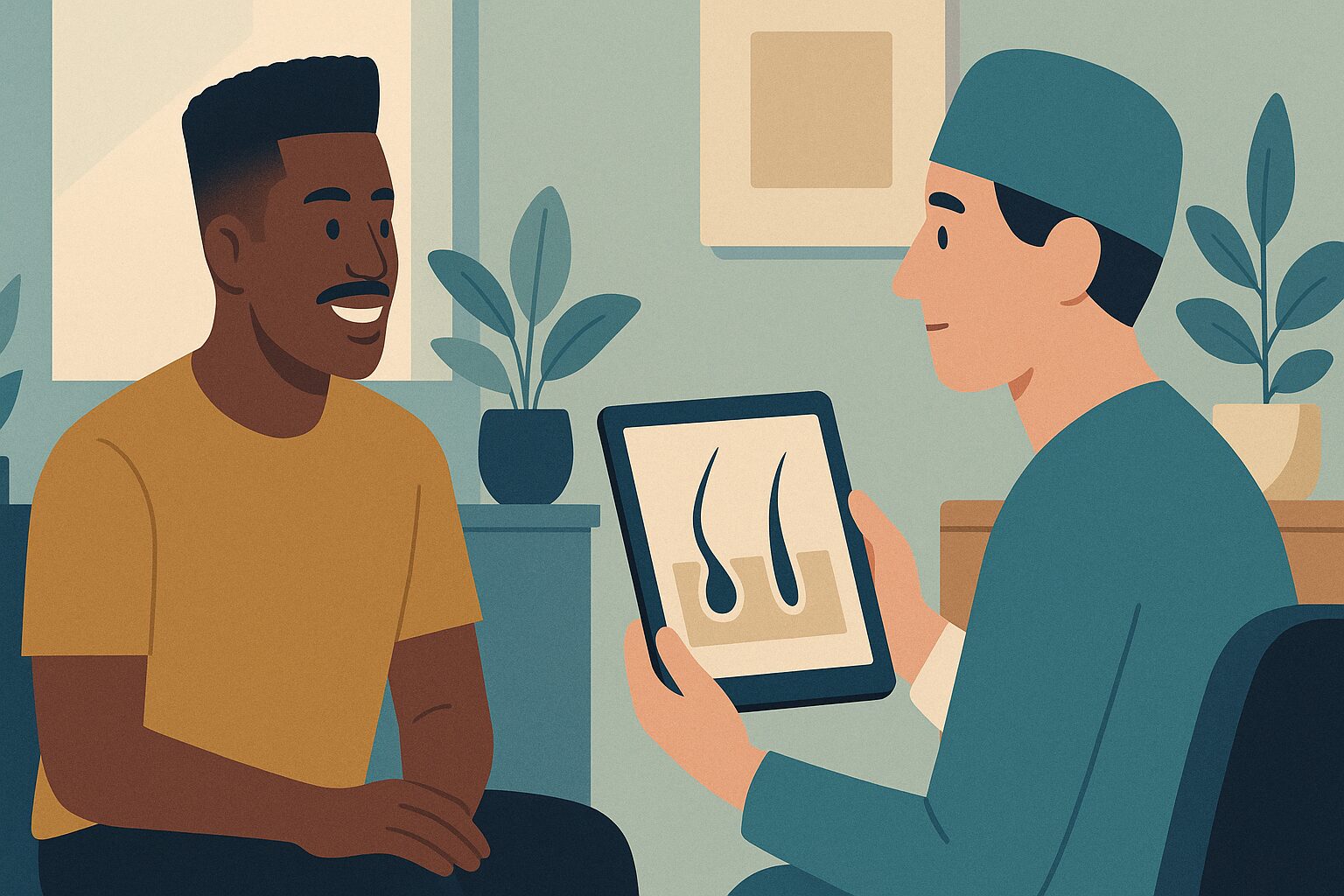
Tightly curled hair is harder to extract but easier to cover with. The follicle curves beneath the skin, so extraction demands a different technique — but each curled hair shades far more scalp than a straight one, and a graft count that would look sparse on straight hair can look full on textured hair.
The risk that actually deserves attention is not extraction difficulty. It is scarring tendency in the donor area, and transplanting into traction damage that has not been stopped.
Textured and Afro-type hair is routinely described as difficult to transplant, which is true in a narrow technical sense and misleading as a summary. At HairX Clinics the planning differs in specific, identifiable ways — the extraction, the channel angle, the graft count, and the pre-operative conversation about scarring. This guide sets out each of them, and the one situation where we would decline to operate until something else is addressed first.
Why is extraction different?
A straight hair sits in a follicle that runs more or less straight down through the skin. You can see the direction it leaves the scalp and infer the direction of the root beneath.
A tightly curled hair does not do this. The curl begins below the surface, so the follicle arcs as it descends. A punch aligned with the visible hair will therefore cut across the follicle a few millimetres down — transecting it, and producing a graft that may not grow.
Managing this is a matter of technique rather than equipment: slower extraction, a slightly larger punch, careful reading of the curve on the first few grafts of each zone, and a willingness to adjust angle graft by graft. It is one of the clearest cases where who performs the extraction matters more than which device is used — a theme we return to in how to choose a clinic.
Why can fewer grafts be enough?
Coverage is an optical property, not just a numerical one. A curled hair occupies volume rather than lying flat; it casts shadow, overlaps its neighbours, and obstructs the line of sight to the scalp from many more angles than a straight hair does.
The practical consequence is that graft numbers quoted in generic online calculators tend to overstate what textured hair requires for a given area. Two people with identical recession may need meaningfully different numbers, with the curlier hair needing fewer.
| Planning factor | Straight or wavy hair | Tightly curled hair |
|---|---|---|
| Extraction speed | Faster | Slower — curve must be followed |
| Punch selection | Smaller punch usual | Often slightly larger to avoid transection |
| Grafts for equivalent coverage | Higher | Frequently lower |
| Hairline construction | Single hairs, soft irregular edge | Same principle, but curl hides small irregularities |
| Donor scarring risk | Standard | Higher tendency to hypertrophic or keloid scars |
| Most common reason for presenting | Pattern hair loss | Pattern loss and traction alopecia |
These are planning generalisations, not rules — hair texture sits on a spectrum and individual assessment decides the number. The method for arriving at it is the same one described in how many grafts you need.
What about scarring?
This is the conversation that should happen before booking, and frequently does not.
Some people scar more readily than others, and a raised or keloid scarring tendency is more common in patients with Afro-textured hair. Follicular unit extraction leaves many small circular wounds in the donor area rather than one line, which generally heals inconspicuously — but in a scar-prone patient those dots can become raised and visible, particularly with short hair.
- Declare any previous keloids. Ear piercings, surgical scars, acne scars on the chest or shoulders — all are relevant history.
- Ask about a test area. A small number of extractions in a discreet part of the donor zone, assessed after healing, gives real information rather than a guess.
- Discuss punch size explicitly. There is a trade-off here: larger punches reduce transection but leave larger wounds.
- Plan for how you wear your hair. A donor area that is invisible under a grown-out style may be visible under a fade.
Why does traction alopecia have to be stopped first?
Traction alopecia comes from sustained pull on the follicle — tight braids, weaves, locs under tension, extensions, or a tightly worn covering. It typically shows at the frontal hairline and above the ears, and in its early stages it is fully reversible by removing the tension.
That reversibility is the whole point. If the pull continues, transplanted grafts are subjected to exactly the force that destroyed the original hair, and the loss simply repeats — at the patient’s expense.
So the sequence is not negotiable: change the styling, allow several months, reassess. Whatever has recovered on its own is hair nobody had to pay for. Only what remains missing after that is a surgical question. Early traction that has not yet scarred often needs no surgery at all.
Where traction has been present for years, follicles may be permanently scarred, and a transplant then becomes reasonable — provided the tension is genuinely gone. The hairline design in these cases follows the same principles as any other, set out in designing a natural hairline, with the added consideration that the original hairline position should be restored rather than lowered.
For women, where traction and pattern loss frequently coexist, the broader planning differences are covered in hair transplant for women.
Does curly hair have a lower graft survival rate?
Survival depends on how the graft is extracted and handled, not on curl itself. A follicle removed intact behaves like any other. The risk with curled hair is transection during extraction, which is a technique variable rather than an inherent property of the hair.
Will my transplanted hair grow back curly?
Yes. The graft carries its own characteristics with it, so hair moved from the back of the scalp keeps the texture, curl pattern and colour it had there. This is why donor hair is chosen to match the receiving area.
Is DHI better than FUE for textured hair?
The distinction is often overstated in marketing — DHI is a method of implanting, not a separate operation, and both approaches extract grafts the same way. For curled follicles the decisive factor is extraction technique, which is shared by both.
Can locs be worn after a transplant?
Once healing is complete and only if they are not worn under tension. Locs themselves are not the problem; weight and pull at the root are. This is worth planning with your loctician and your surgeon rather than resuming the previous routine.
How soon can I get a fade again?
Not until the donor area has fully settled, which takes longer than most people expect — clipper work on a healing donor zone can irritate it and makes any raised healing more obvious. Your surgeon should give you a date at the follow-up rather than a general rule.