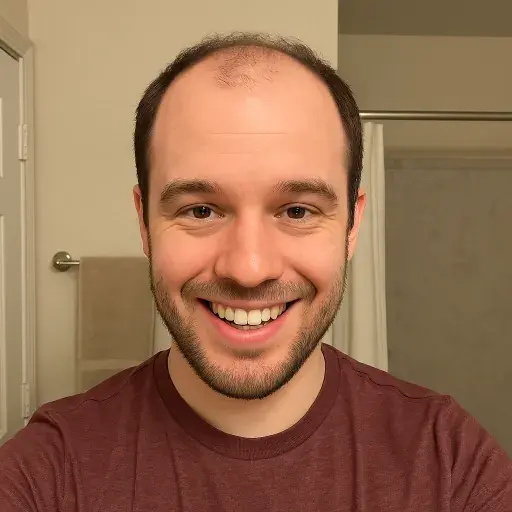
A hairline that moves back evenly, by about one to one and a half centimetres, and then stops is a maturing hairline — normal, and not hair loss. A hairline that keeps going, thins at the temples faster than the centre and carries the hair behind it with it, is receding.
The distinction matters because nothing regrows a hairline that has already gone. Medication holds the line behind it; only surgery moves the line forward.
The receding hairline is the most searched hair-loss question there is, and the most badly answered. Most of what ranks either sells a shampoo or tells a twenty-two-year-old with a perfectly normal adult hairline that he is going bald. HairX Clinics sees both extremes in consultation: men who have waited a decade too long, and men who have not started losing anything yet. This guide covers how to tell the difference, what actually drives recession, what each treatment can and cannot do, and when surgery becomes the honest answer.
What is a receding hairline?
A receding hairline is the backward migration of the frontal hairline caused by androgenetic alopecia — pattern hair loss. Follicles at the front and temples are genetically sensitive to dihydrotestosterone, a hormone derived from testosterone. Over repeated growth cycles those follicles miniaturise: each new hair comes back finer, shorter and lighter than the last, until the cycle stops producing a visible hair at all.
That is why a receding hairline rarely looks like hair falling out in handfuls. It looks like the front of your head slowly becoming less substantial — wispy baby hairs where thick hair used to be, a hairline you can see your scalp through in bright light, temples that retreat while the forelock holds on.
Is it receding, or is it just maturing?
Here is the thing almost nobody tells men in their twenties: the hairline you had at sixteen was never going to be the hairline you keep. Between roughly the late teens and the mid-twenties, most men lose the low, straight, rounded juvenile hairline and settle into an adult one that sits higher and takes on a shallow V at the temples. This is called hairline maturation. It is not pattern hair loss, it does not continue, and it needs no treatment.
| Maturing hairline | Receding hairline | |
|---|---|---|
| Timing | Late teens to mid-twenties, then stops | Starts at any adult age and continues |
| Shape | Moves back fairly evenly, shallow temple recession | Temples retreat far ahead of the centre |
| Distance | Roughly 1–1.5 cm above the highest forehead crease, then stable | Keeps moving back year on year |
| Hair quality behind the line | Thick, pigmented, unchanged | Finer, shorter, patchier — miniaturising |
| Crown | Unaffected | Often thinning at the same time |
| Family pattern | Everyone has one | Usually echoes a relative’s pattern |
How do you know if your hairline is receding?
The honest answer is that one look in the mirror tells you very little. Recession is slow, and the brain adjusts to a face it sees every day. What works is evidence:
- Photograph it properly, and repeat. Same room, same light, hair dry and pushed back, front and both temples, every three months. Two photographs six months apart settle the question that six months of worrying cannot.
- Look at hair calibre, not hair count. Miniaturisation shows up as fine, colourless hairs mixed in among normal ones along the front. That mix is the early signature of pattern loss, and it appears before the line visibly moves.
- Check the temples against each other and against the centre. Pattern loss usually runs ahead at the temples. Even, symmetrical movement with thick hair behind it is far more likely to be maturation.
- Check the crown in a second mirror. A front that is moving while the crown is also thinning is a strong pointer to pattern hair loss rather than maturation.
- Ask about the family, on both sides. Pattern baldness is polygenic and is not inherited purely from the mother’s father, whatever you have been told.
If you want a structured read rather than a self-assessment, the Norwood scale is the standard way surgeons describe where a pattern has reached, and the free HairX AI Hair Analysis returns a per-zone read from photographs, including a four-frame timeline and a PDF you keep.
What causes a receding hairline?
In the overwhelming majority of cases the answer is genetics and hormones acting together over time. The other causes matter mainly because they are the ones you can do something about, and because mistaking one for the other wastes years.
| Cause | What it looks like | Reversible? |
|---|---|---|
| Androgenetic alopecia | Gradual, patterned, temples first, hairs miniaturise | No — but it can be slowed and held |
| Traction alopecia | Follows tight styling, turbans, tight hijab, man-buns; often a thin band at the very front | Often, if caught before scarring |
| Telogen effluvium | Diffuse shedding all over 2–3 months after illness, surgery, crash dieting or major stress | Yes, usually within months |
| Thyroid disorder, iron or vitamin D deficiency | Diffuse thinning, not a moving frontal line | Yes, when the underlying problem is treated |
| Frontal fibrosing alopecia | Band-like recession with loss of eyebrows, most often in women after menopause | No — it scars, so early specialist referral matters |
The last row is the reason a moving hairline in a woman is never assumed to be ordinary pattern loss. Scarring alopecias destroy the follicle permanently and behave differently from everything above them in that table.
How do you fix a receding hairline?
This is where the honest answer is unpopular. No medication, device or topical product moves a hairline forward. Once the frontal follicles have gone, there is nothing there to stimulate. What proven treatment does is defend the hair you still have and thicken what is miniaturising but alive — which, if you start early enough, means the line stops where it is.
- Finasteride. A prescription DHT blocker, the mainstay of slowing pattern loss. Works best on hair still present. Needs a doctor, has a side-effect profile worth discussing, and stops working if you stop taking it. See our guide to finasteride for hair loss.
- Minoxidil. Topical or oral, it extends the growth phase and can thicken miniaturised hair. Historically weakest at the very front. More on how minoxidil works.
- Treating the treatable. Iron, vitamin D and thyroid problems will not cause a patterned recession, but they will make everything worse and they are worth ruling out.
- Stopping the mechanical cause. If tension is pulling the front out, loosening it is the whole treatment — and it only works before scarring.
- A hair transplant. The only intervention that puts hair where hair no longer grows, by moving DHT-resistant follicles from the back of the scalp to the front.
Can you regrow a hairline naturally?
Not in the sense the question usually means. Rosemary oil, onion juice, castor oil, derma-rollers used unsupervised, biotin taken by people who are not deficient in biotin — none of these regrow a hairline lost to pattern baldness, and no amount of consistency changes that. Some improve scalp condition or hair cosmetics, which is a real but much smaller thing.
What genuinely helps, and gets ignored because it is unexciting: not pulling the hair tight, not smoking, treating a diagnosed deficiency, and starting proven medical treatment early rather than after three years of trying everything else. The years spent on the alternatives are the actual cost, because they are years the pattern keeps advancing.
Find out whether your hairline is moving — before deciding anything
The free HairX AI Hair Analysis reads photographs of your own scalp and returns a per-zone graft estimate, a four-frame day-1 to month-12 timeline, a written surgical rationale and a PDF you keep. A HairX surgeon then reviews it with you in person or online, including the case for waiting rather than operating.
When does a transplant become the right answer?
A hairline transplant becomes reasonable when the loss is established rather than early, when the pattern has been stable or medically controlled for a period, and when the donor area at the back and sides can supply what the front needs without being stripped to do it. Those three conditions are also the reasons HairX declines cases — an unstable pattern in a young patient, or a donor area that cannot fund the plan, is not improved by operating on it sooner.
Design is the other half. A transplanted hairline that is too low, too straight or too dense at the corners reads as artificial for the rest of a person’s life, and it spends donor hair that can never be recovered. Our guide to how a natural hairline is designed covers the reasoning surgeons use, and the free graft calculator gives a planning range for the zones you want covered.
Both HairX medical teams, Egyptian and Turkish, work in FUE and DHI, and follow-up after surgery can be in person or online — which matters if you are reading this from outside Egypt.
At what age does a hairline normally start receding?
Hairline maturation typically happens between the late teens and mid-twenties and then stops. True pattern recession can begin in the twenties, thirties or later, and the earlier it begins the more aggressive the eventual pattern tends to be. Age alone does not distinguish the two — progression over time does.
Can a receding hairline grow back on its own?
A hairline lost to pattern baldness does not grow back on its own. A hairline that thinned because of a temporary shedding event, iron deficiency or tension from tight styling often does recover once the cause is removed, which is exactly why the two are worth telling apart before spending money on treatment.
Does wearing a hat cause a receding hairline?
No. Ordinary hats do not cause pattern hair loss. Headwear worn extremely tight, for long periods, day after day, can contribute to traction alopecia at the front — but that is a different condition with a different appearance, and it is caused by tension, not by covering the head.
Is a receding hairline in women the same condition?
Often not. Women more commonly show a widening central part rather than a moving frontal line, and a genuinely receding hairline in a woman — especially with eyebrow loss — needs specialist assessment because scarring alopecias present that way and are treated differently.
Should I start finasteride before considering a transplant?
That is a decision for a doctor who has examined you, not a general rule. What is general: surgery does not stop pattern loss continuing behind the transplanted line, so the plan for the untransplanted hair is part of the surgical plan, not a separate question to settle later.
See your result before you book. A full year of it, from photos on your phone.
HairX shows you a twelve-month AI preview of your result and an estimated graft count before you speak to anyone. It is free and it takes minutes. The report covers your stage of hair loss, what your donor area can realistically give, and how the result comes in month by month, including the third month, when it looks worse before it gets better.