
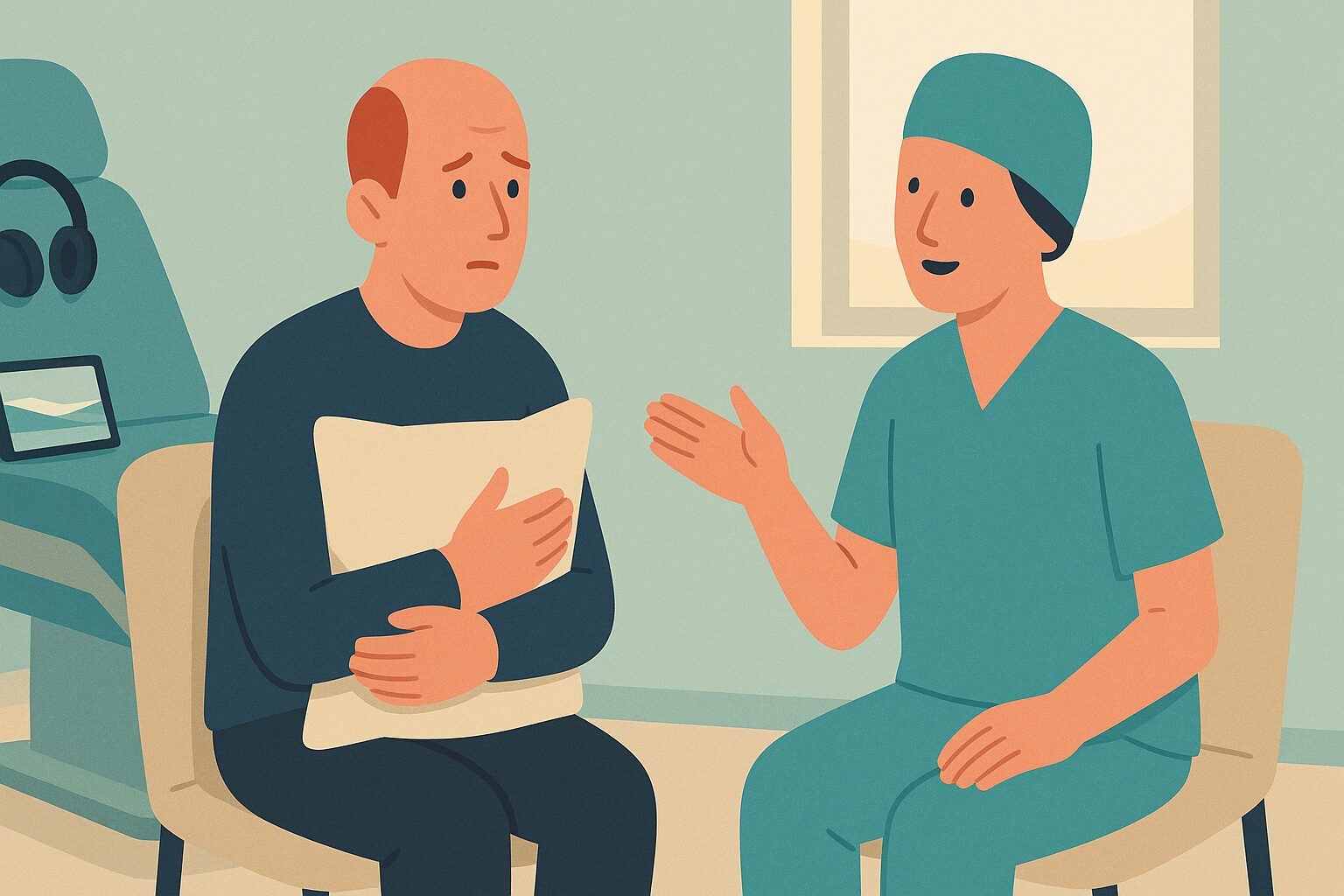
Hair transplantation is performed under local anaesthesia in the overwhelming majority of cases worldwide, usually with mild oral sedation. You are awake, comfortable and able to eat, talk and use your phone through most of the day.
General anaesthesia is avoided not because clinics are cutting corners but because it makes a safe procedure less safe: it adds airway and cardiovascular risk to an operation that does not enter a body cavity, and it removes the feedback a conscious patient gives.
The request comes up often at HairX Clinics, almost always from someone bracing for pain they have imagined in detail. It is a fair thing to ask about. The answer below covers what is actually felt and when, why the anaesthetic choice is a clinical one rather than a comfort preference, and the narrow situations in which the calculation changes.
What does the day actually feel like?
The only genuinely uncomfortable part is the first few minutes: the injections that numb the donor area and later the recipient area. Fine needles, a stinging sensation, and it is over. Modern practice reduces even that with very fine gauges, buffered solutions and vibration or cooling at the injection site.
After that, the scalp is numb. Extraction and implantation are felt as pressure and movement rather than pain, and top-up anaesthetic is given through the day as the earlier doses wear off. Most patients describe the dominant sensation of the day as boredom and a stiff neck. A fuller account is in our guide to whether a hair transplant hurts.
Why is local the standard rather than a compromise?
Three reasons, and they compound.
| Local anaesthesia with light sedation | General anaesthesia | |
|---|---|---|
| Risk profile | Local, limited, dose-managed | Adds airway and cardiovascular risk |
| Facility required | Properly equipped clinic theatre | Hospital with anaesthetic and recovery capability |
| Patient repositioning | Patient shifts, sits, takes breaks | Must be moved; pressure points a concern |
| Pain as a warning signal | Available throughout | Absent |
| Session length flexibility | Can extend as needed | Pressure to finish quickly |
| Recovery | Walk out the same day | Monitored recovery, grogginess, nausea |
The fourth row is the one that surprises people. Pain during a procedure is information. A patient who reports a sharp sensation in one area tells the surgeon that anaesthesia has worn thin there before anything is done to under-anaesthetised tissue. Remove that channel and you are working blind to it.
The fifth matters too. A graft session is long by nature, and the best results come from taking the time each stage needs. General anaesthesia introduces a clock that nobody benefits from.
What about sedation, then?
Sedation is a spectrum rather than a switch, and this is where genuine choice exists. A mild oral sedative taken before the numbing injections takes the edge off anxiety while leaving you awake, responsive and able to tell the team what you feel. It is common, well established and appropriate for most anxious patients.
Deeper intravenous sedation sits closer to general anaesthesia in what it requires: monitoring, trained staff, and equipment to manage an airway if needed. It is occasionally used, and when it is, it should come with the same seriousness of assessment as any anaesthetic.
- Declare every medication. Blood thinners, heart and blood pressure medicines, antidepressants and diabetes treatment all affect the plan.
- Declare every condition. Heart disease, uncontrolled hypertension, sleep apnoea, epilepsy, bleeding disorders and previous anaesthetic reactions.
- Do not self-medicate for nerves. Taking a sedative you were not prescribed, or alcohol the night before, changes the anaesthetic calculation without anyone knowing.
- Arrange a lift home. Even mild sedation means you should not drive afterwards.
- Ask who administers what. You are entitled to know who is giving the anaesthetic and what their qualification is.
Are there cases where it is reconsidered?
A few, and they are medical rather than preferential. Patients who cannot remain still for medical reasons, those with certain neurological or psychiatric conditions, and reconstructive cases combined with other surgery under one anaesthetic are all situations where the balance can shift. In each, the decision belongs to an anaesthetist working with the surgeon, in a facility equipped for it.
What does not shift the balance is simply preferring to be asleep. Declining that request is not inflexibility; it is the same judgement that keeps the procedure in the low-risk category patients chose it for.
Does the anaesthetic choice affect recovery?
Yes, in your favour. Local anaesthesia means no post-anaesthetic grogginess, nausea or sore throat, and you leave on the same day having eaten normally. The numbness fades over the following hours and mild soreness is managed with simple painkillers on your surgeon\u2019s advice. The rest of the timeline is set out in our day-by-day recovery guide.
Will I feel the grafts being placed?
Pressure and movement, not pain. If anything becomes sharp, say so immediately and more anaesthetic is given. That is the system working as intended.
Can I sleep through it anyway?
Many people doze during the long middle hours, especially with mild sedation. That is different from being anaesthetised, and you remain rousable and able to communicate.
Is the numbing injection very painful?
It stings for a few minutes and is the worst part of the day for most patients. Fine needles, buffered solution and distraction techniques reduce it considerably.
What if I have a needle phobia?
Say so at consultation rather than on the day. Pre-medication, technique adjustments and pacing can all be planned in advance when the team knows.
Can I take my regular medication that morning?
Only as instructed by the clinic. Some medicines continue as normal and others are adjusted or paused, which is exactly why the medication review matters.