
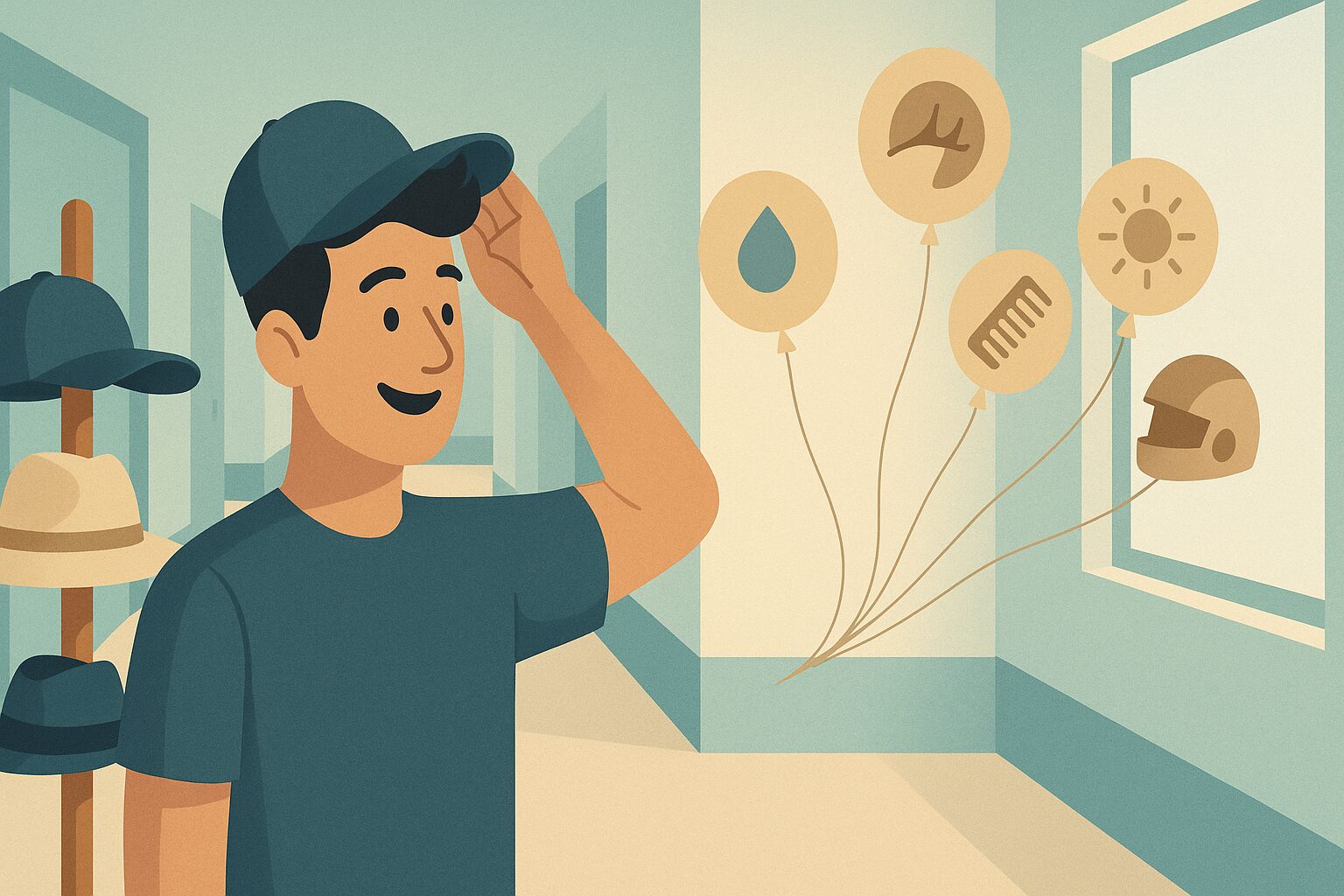
Wearing a hat does not cause pattern hair loss. Follicles are fed by blood vessels beneath the skin, not by air above it, and no ordinary cap is tight enough to change that.
The reason the belief survives is more interesting than the myth: hats conceal thinning while it progresses. Men who wear one daily often notice the loss later and arrive at a clinic further along than men who do not. The association people observe is real; the direction of cause is backwards.
Almost every consultation at HairX Clinics includes at least one of these beliefs, usually offered apologetically. They are worth taking seriously rather than laughing at, because each one contains a grain of something true that got attached to the wrong conclusion. Here are five, and what the grain actually is.
Myth one: hats suffocate the follicle
The follicle sits in the dermis and receives oxygen through the bloodstream. Scalp skin does not breathe in any sense that a hat could interrupt, which is why people who wear helmets all day for work do not go bald as a group.
There is one narrow exception, and it is about tension rather than coverage. Persistent, strong pulling on hair over years can damage follicles at the hairline. That is traction alopecia, and it comes from tight braids, extensions and tightly pinned coverings, not from a baseball cap. A hat so tight it leaves a lasting mark is worth loosening; a normal one is irrelevant.
Myth two: shaving makes hair grow back thicker
A hair shaft tapers towards its tip. Cutting it removes the fine end and leaves the blunt, wider section at the surface, so regrowth feels coarser and looks darker for a week or two. Nothing has happened below the skin, where the only thing that determines shaft thickness is the follicle.
This one matters practically. Men sometimes shave their heads expecting to reset something, then read the stubble field as evidence of density. It is not a measurement. The reliable way to track thinning is photographs from a fixed angle, matched against a stage on the Norwood scale.
| The belief | The grain of truth in it | What is actually happening |
|---|---|---|
| Hats cause baldness | Cap wearers do present later and balder | Concealment delays noticing, not causes loss |
| Shaving thickens hair | Stubble genuinely feels coarser | A blunt cut end, not a changed follicle |
| Washing makes hair fall out | You see more hair on wash days | Already-shed hairs released together |
| High testosterone means baldness | Hormones do drive the process | Follicle sensitivity matters, not blood levels |
| Poor blood flow starves follicles | Blood supply is real and does matter | Massage does not change the hormonal cause |
Myth three: washing your hair makes it fall out
Shedding is continuous, but shed hairs do not leave the head at the moment they detach. Many stay caught in surrounding hair until something dislodges them. Washing does that, so wash day looks dramatic and the day after looks fine.
Hence the trap: someone alarmed by the drain reduces washing to twice a week, and the next wash releases several days of accumulated shedding at once. The pile is bigger, the alarm grows, the washing reduces further. Meanwhile an unwashed scalp with seborrhoeic dermatitis becomes inflamed, which does nothing helpful for hair.
Myth four: baldness means high testosterone
The folklore runs in both directions, and both are wrong. Pattern hair loss is not a marker of virility, and it is not a sign of hormone deficiency either. Men with entirely ordinary hormone levels lose hair, and men with high levels keep it.
What differs is inherited receptor sensitivity in the follicles themselves. That is why the pattern is so specific: the crown and hairline thin while the back and sides, whose follicles are not sensitive, stay put for life. That difference is the whole basis of transplant surgery and the reason transplanted hair keeps growing where it is moved to.
Myth five: scalp massage and blood flow will regrow it
Circulation is not the limiting factor in androgenetic hair loss. A scalp with pattern thinning is not short of blood; its follicles are responding to a hormonal signal by shortening their growth cycles.
Massage is pleasant, harmless in moderation, and may help you apply a topical treatment evenly. Vigorous daily rubbing with oils, by contrast, causes friction breakage that looks like loss. The distinction between treatments with evidence and rituals without it is set out in our guide to hair loss treatment.
So what does actually make a difference?
Three things, and none of them is a habit you need to feel guilty about. Genetic susceptibility, which sets the trajectory. Time, which is why early treatment protects more than late treatment restores. And whether an unrelated cause is sitting on top of the pattern, since thyroid disease, iron deficiency and rapid weight loss all add shedding that is reversible once found.
That list is short on purpose. The energy spent auditing hats, shampoos and pillowcases is energy not spent on the two questions that change outcomes: what stage am I at, and is anything else going on.
Can a tight helmet worn daily cause damage?
Sustained tension and friction can contribute to breakage and, over years, to traction damage at the edges. Proper fit and padding solve this; the issue is pulling, not covering.
Does sweating under a cap harm the scalp?
Sweat itself does not, but a persistently damp, unwashed scalp can aggravate seborrhoeic dermatitis. Wash normally and let hats dry between wears.
Is it safe to wear a hat after a hair transplant?
Only when your surgeon says so, and only a loose one. Early on, anything that rubs or presses on grafts risks dislodging them, so the timing is a clinical decision.
How many hairs a day is normal to lose?
Daily counts vary so much with hair length, washing and styling that they are a poor measure. Sustained change over months, and thinner regrowth, tell you far more than any single day.
Does hard water or chlorine cause hair loss?
They affect the hair shaft, causing dryness and breakage that reduce apparent volume. They do not affect the follicle, so they do not cause pattern loss.