
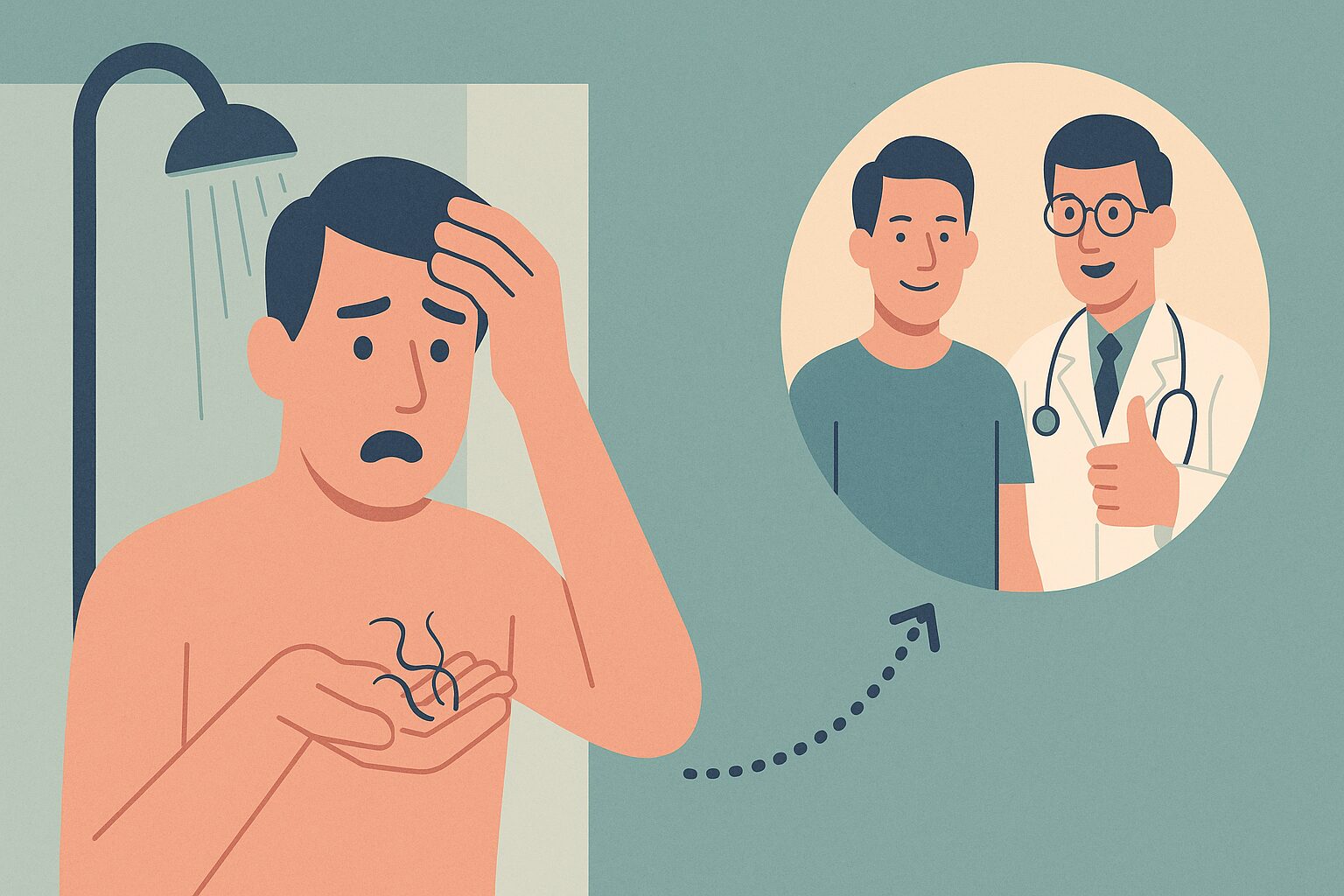
There is a counter-intuitive rule that sorts most cases quickly. Sudden, heavy, frightening shedding is usually the reversible kind — a telogen effluvium that stops on its own within months. The kind that causes permanent loss, androgenetic thinning, sheds no more hair than normal.
Which means the symptom that sends people rushing for help is the one that generally resolves, and the one that quietly takes your hair produces nothing dramatic to notice at all.
Getting the category right is the whole game. Every treatment discussed at HairX Clinics depends on it, because the right answer for one type is a waste of a year for another. Five categories cover the overwhelming majority of what walks through the door.
Androgenetic: the slow one
Inherited sensitivity to DHT shortens the follicle\u2019s growth cycle over years. Each cycle produces a slightly finer hair until it stops altogether. There is no dramatic shedding phase because the hairs are being replaced, just by progressively thinner ones.
The tell is not volume, it is calibre. Compare hair from the thinning area with hair from the back of the head: in androgenetic loss the affected area contains thick and very fine strands side by side. Staging follows the Norwood scale in men. This is the only type on this list for which transplantation is the standard answer.
Telogen effluvium: the dramatic one
A systemic shock pushes an abnormally large share of follicles into the resting phase simultaneously. Two to four months later they release together, and hair comes out in handfuls. Common triggers: childbirth, high fever, surgery, crash dieting, severe stress, stopping certain medications.
Two features identify it. The delay — the cause is months in the past, not last week, which is why people blame the wrong thing. And the uniformity: it thins everywhere at once rather than in a pattern. It stops by itself, typically within six to nine months, and density returns over the following year.
| Androgenetic | Telogen effluvium | Alopecia areata | Traction | Scarring | |
|---|---|---|---|---|---|
| Speed | Years | Weeks | Days | Years | Months to years |
| Shedding volume | Normal | Very high | Normal | Normal | Variable |
| Shape | Pattern | All over | Round patches | Edges, hairline | Irregular |
| Scalp appearance | Normal | Normal | Normal | Normal | Shiny, red or scaly |
| Reversible? | No, but treatable | Yes, on its own | Often | Only if caught early | No |
| Urgency | Moderate | Low | See a dermatologist | Change the styling now | Urgent |
Alopecia areata: the patchy one
An autoimmune condition producing round or oval patches with sharp borders on otherwise normal skin. It can affect the beard, eyebrows and lashes as well as the scalp. Limited patches often regrow spontaneously.
It matters here for one reason: it is the clearest contraindication to a transplant there is, because donor follicles carry no protection against an immune attack. That case is set out in full in our guide to alopecia areata versus pattern baldness.
Traction: the avoidable one
Sustained pulling on the hair damages follicles at the points of highest tension — usually the hairline and temples. Tight braids, extensions, weaves, tightly pinned coverings and habitual very tight ponytails are the usual causes, acting over years rather than weeks.
It is the only type on this list that is entirely preventable, and the only one where the single most effective intervention costs nothing: change the styling. Caught early, follicles recover. Left long enough, the damage becomes scarring and does not.
Scarring alopecias: the urgent one
A group of inflammatory conditions that destroy the follicle and replace it with fibrous tissue. Once that has happened nothing regrows there, and no treatment or surgery changes it.
Unlike everything else on this list, the scalp itself looks abnormal — shiny and smooth where follicle openings have disappeared, or red, scaly or tender at the active edge. Symptoms such as burning, itching or soreness are common and are worth taking seriously.
What if more than one is happening?
Common, and the usual reason people conclude that nothing works. A man with early androgenetic thinning who then has surgery and a period of illness will shed heavily for a few months. The effluvium resolves, he decides the crisis has passed, and the pattern loss continues underneath at its own pace.
The way through is sequencing rather than cleverness. Let the reversible component settle, correct anything treatable, then reassess what is left — and judge it on photographs from a fixed angle, not on how the mirror felt this morning. That order underpins our guide to what actually works for hair loss.
How many hairs a day is normal to lose?
Counts vary so much with hair length, washing and styling that they are a weak measure. Whether shedding is still heavy after several months, and whether regrowth is finer, tell you far more.
Can I tell the type from a photograph?
Sometimes the shape suggests a category, but distinguishing early scarring loss from ordinary thinning needs the scalp examined under magnification. That distinction is the one you cannot afford to get wrong.
Which types can a transplant treat?
Androgenetic loss primarily, once stable, and some stable scar or trauma cases assessed individually. Active autoimmune or active scarring conditions are not candidates.
Does hair loss from medication have its own category?
It usually presents as telogen effluvium, with the same delay and the same diffuse pattern. Never stop a prescribed medication over hair loss without speaking to the prescriber.
Is shedding after a transplant one of these?
That is shock loss, a temporary effluvium around the operated area that resolves as the follicles restart. It is covered in our guide to shock loss after a transplant.