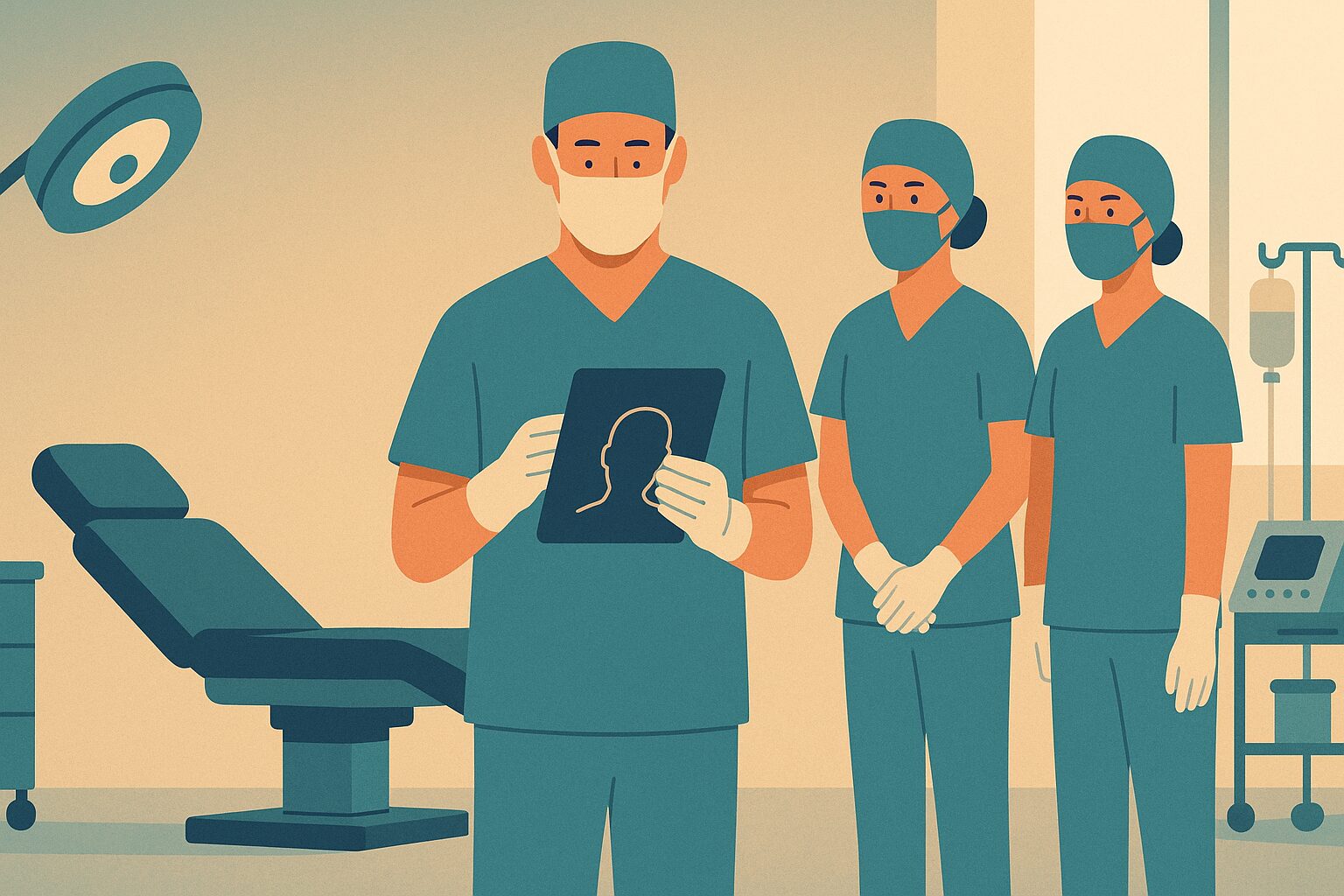
In most countries, trained technicians legally assist with graft extraction and placement, and that is normal practice rather than a scandal. What must stay with the doctor is the diagnosis, the hairline design and the channel creation — the three decisions that determine how the result looks for the rest of your life.
So the useful question is not will a doctor do my surgery. It is how many patients is that doctor covering today.
Almost every clinic website says the words doctor-led or surgeon-performed. Almost none of them define what that covers. A hair transplant is a team procedure everywhere in the world, so the phrase is true in some form at nearly every clinic, which makes it close to meaningless as a way of telling clinics apart. This guide from HairX Clinics sets out what the team actually does, hour by hour, and which parts genuinely need the surgeon’s hands.
Who does what during the procedure?
A session of several thousand grafts cannot be done by one pair of hands in a day. The work splits roughly like this:
| Stage | Typically performed by | Why |
|---|---|---|
| Consultation and diagnosis | Doctor | Requires differentiating pattern loss from other conditions |
| Hairline design and drawing | Doctor | An aesthetic and long-term judgement, not a manual task |
| Anaesthesia | Doctor | A medical act with dosing and safety implications |
| Graft extraction | Doctor and trained technicians | Repetitive, requires consistency over many hours |
| Graft sorting and preservation | Technicians | Meticulous handling work under magnification |
| Channel creation in the recipient area | Doctor | Sets angle, direction and depth for every graft |
| Graft placement into channels | Technicians, supervised | The channel already dictates the outcome |
| Post-operative review | Doctor | Assessment of donor and recipient areas |
Read that table again with one thing in mind: the channels decide everything. Once a channel is cut at a given angle and depth, the graft placed into it can only follow. A technician placing grafts into well-made channels produces a natural result. A surgeon placing grafts into badly angled channels does not.
Which steps must the surgeon perform?
Three, and they are not negotiable:
- The diagnosis. Deciding that you have pattern loss rather than a scarring or inflammatory condition, and that surgery is appropriate at all. Getting this wrong means operating on a scalp that should have been treated instead.
- The design. Where the hairline sits, how soft its edge is, how the density is distributed, and crucially how much donor hair is held back for the loss that has not happened yet.
- The channels. Angle, direction, depth and spacing across the whole recipient area, including rebuilding the radial pattern in the crown.
Everything else can be shared with a trained team, provided the surgeon is present and supervising. The design question in particular is where most long-term regret originates — not in how the grafts were placed, but in where someone decided to put them. We cover the reasoning in why hair transplants fail.
Where does the technician-led model go wrong?
Three specific failure modes, all of them commercial rather than clinical in origin:
| Pattern | What happens in practice | Effect on the result |
|---|---|---|
| One doctor across many patients in a day | The surgeon appears to design, then moves on | Channels rushed or delegated; inconsistent angles |
| Design delegated entirely | Hairline drawn by whoever is free | Hairlines that ignore future loss and facial proportion |
| No named surgeon | You never learn who operated on you | No accountability if something needs correcting |
| Untrained or rotating assistants | Graft handling quality varies within one session | Patchy growth in some zones and not others |
This is also why price alone is a poor proxy for quality in either direction. A low price can reflect lower overheads in a country with a lower cost base, or it can reflect a clinic running four patients at once. The figure tells you nothing without the staffing answer behind it. Our honest assessment of the high-volume market is in hair transplant in Turkey.
What should you ask before booking?
- Who will design my hairline, and will I meet them before the day? A design drawn on your scalp by someone you have met is a different commitment from one drawn an hour before surgery.
- How many patients will that doctor have on my day? The honest answer is a number. Vagueness here is itself the answer.
- Who creates the channels? The one technical question worth insisting on.
- Are the technicians employed here full-time? Rotating freelance teams are harder to hold to a standard.
- Will the operating surgeon be in the room throughout? Present and supervising is not the same as available on site.
- Who do I contact at month six if I am worried? Ask for the name and the route, not a general number.
A clinic that answers all six plainly is telling you how it works. One that answers with marketing language is also telling you something. More of these questions are gathered in what to ask at a consultation and how to choose a clinic.
Meet the doctor who will design your hairline
At HairX the consultation is with the doctor who plans your case: your scalp and donor area are examined, the design is discussed on your own head, and you are told how the day is staffed. Egyptian and Turkish medical teams, FUE and DHI, and a named point of contact for the months afterwards.
What answers should concern you?
Not every imperfect answer is a red flag, but these four are worth pausing on:
- “Our doctors are all specialists” with no name offered. A named surgeon you can look up is the minimum.
- A quote given before anyone has examined your scalp. Graft numbers priced from a photograph are a sales estimate, not a plan.
- Pressure to confirm today for a discount. Elective surgery does not need a deadline.
- A guarantee with no written terms. Ask what it covers, what proof it needs, and at what month it applies.
None of this requires you to become an expert in surgical technique. It requires you to ask who is doing what, and to notice whether the answer is specific.
Is it legal for technicians to extract and place grafts?
Rules vary by country, and in many places trained technicians assist under medical supervision. Ask your clinic what applies where you are being treated, and who supervises.
Does DHI change who does what?
With an implanter pen, channel creation and placement happen in one motion, so the person holding the pen is setting the angles. That makes the question of who operates the pen more significant, not less. See FUE vs DHI.
Should I refuse any clinic that uses technicians?
That would rule out most reputable clinics worldwide. The meaningful distinction is supervision and continuity, not whether assistants are involved at all.
How do I verify a surgeon is who they say they are?
Ask for their full name and qualification, then check against the relevant national medical register yourself. A clinic with nothing to hide will give you the name without hesitation.
Can I ask to watch or record part of the procedure?
Policies differ and many clinics decline for infection-control and privacy reasons. A more practical request is to meet the surgeon on the morning of the procedure before the design is finalised.
See your result before you book. A full year of it, from photos on your phone.
HairX shows you a twelve-month AI preview of your result and an estimated graft count before you speak to anyone. It is free and it takes minutes. The report covers your stage of hair loss, what your donor area can realistically give, and how the result comes in month by month, including the third month, when it looks worse before it gets better.