
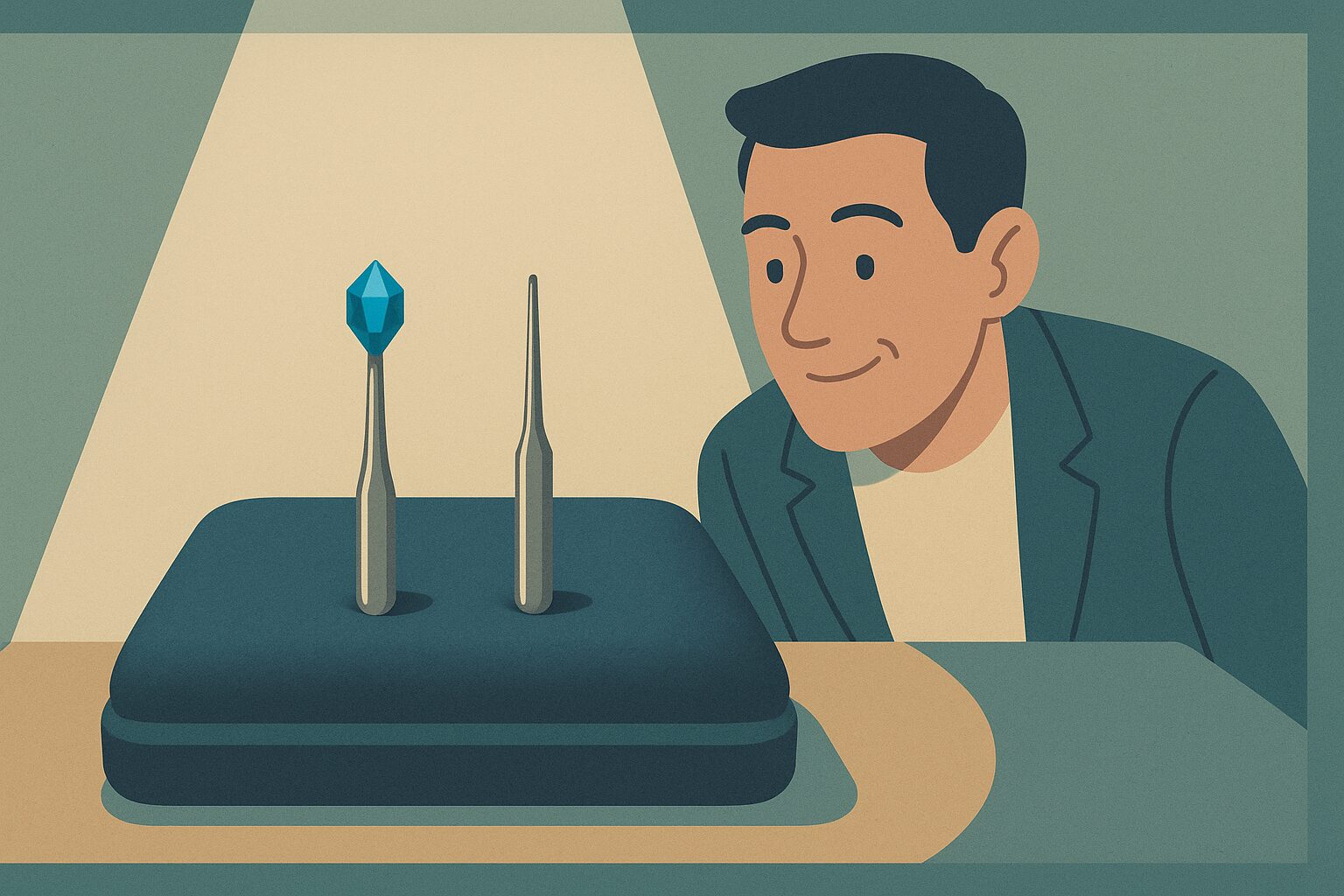
Sapphire is a blade material, not a surgical technique. It replaces the steel blade used to make recipient incisions with a sharpened crystalline tip. Extraction is unchanged, placement is unchanged, and the operation is still FUE.
So when a clinic presents \u201cSapphire FUE\u201d as an upgrade over \u201cFUE\u201d, it is describing the same procedure with a different instrument in one step. The blade has genuine advantages. They are narrower than the marketing, and they matter far less than who is holding it.
The naming in this field is a mess, and sapphire is the clearest example. Patients reach HairX Clinics convinced they must choose between three or four distinct operations when in reality they are choosing between instruments and, in one case, a delivery method. Here is what the blade actually changes.
Where does the blade come into it?
A follicular unit extraction has three stages. Follicles are extracted one by one from the donor area with a punch. Recipient sites are created in the bald area. The grafts are then placed into those sites.
Sapphire concerns the middle stage only. Nothing about extraction changes, and nothing about how grafts are handled or placed changes. Since graft survival depends heavily on extraction quality, time out of the body and gentle handling, the blade is not operating on the variables that most influence your result.
| Stage | What decides the outcome | Does sapphire affect it? |
|---|---|---|
| Extraction | Punch size, angle, operator skill | No |
| Graft handling | Time out of body, storage, gentleness | No |
| Recipient incisions | Depth, angle, direction, density, blade | Yes |
| Placement | Technique, trauma, orientation | No |
| Design | Hairline shape, zone distribution | No |
What does it genuinely offer?
The sapphire tip is harder than steel and holds a finer edge, which supports smaller, more precisely shaped incisions. Smaller incisions mean less tissue disruption, and the proposed consequences follow logically: reduced swelling, quicker crust resolution, and the ability to place sites closer together without compromising blood supply.
Those are reasonable claims and broadly consistent with what surgeons observe. What they are not is transformative. They affect the first week or two of healing and give the surgeon a slightly finer instrument for dense work. They do not change how many grafts survive, how natural the hairline looks, or what the result is at twelve months.
What actually decides the result?
The incision stage does matter enormously — just not because of the blade material. What matters is the judgement applied with it.
- Angle and direction. Hair emerges from the scalp at specific angles that vary by zone. Getting this wrong produces hair that will not sit right, and no blade corrects it.
- Depth. Too shallow and grafts sit proud; too deep risks pitting and poor growth.
- Density and spacing. Sites placed too close compete for blood supply, and survival falls.
- Irregularity at the hairline. A natural front line is deliberately imperfect, as set out in our guide to hairline design.
- Who makes them. Whether the surgeon creates the sites personally or delegates is a far bigger variable than the instrument.
Put plainly: an experienced surgeon using steel will produce a better result than an inexperienced one using sapphire, every time. The blade is a refinement on top of skill, not a substitute for it.
Should you pay more for it?
Only if the rest of the quote already stands up. A sapphire premium on a plan where the operating surgeon is unnamed, the daily caseload is unstated and there is no follow-up schedule is a premium on the wrong thing entirely.
Reverse the order of questions. Establish who operates and how many cases they take that day. Establish the per-zone plan and the donor supply remaining. Establish the follow-up. If two clinics are equivalent on all of that and one uses sapphire, the blade is a reasonable tiebreaker. It is a poor first criterion.
Does it change recovery?
Modestly, and mostly in the first fortnight. Smaller incisions tend to mean less swelling and crusts that clear a little sooner. What does not change is the timeline that actually governs your result: shedding of the transplanted shafts within weeks, a quiet period of several months, then growth from around month four. That sequence is set out day by day in our recovery guide, and no blade shortens it.
Is sapphire FUE available in Egypt, and does it cost more?
Yes, most Egyptian clinics advertise it, HairX included. At HairX it sits inside the same published range as any other method, EGP 45,000 to 100,000 for the whole procedure, set after the donor exam. Elsewhere you will often see sapphire priced as a premium. Since it changes the blade and not the extraction, ask what you are getting for the difference before you pay it.
Is sapphire better than steel?
It offers finer, more precise incisions and may ease early healing. It does not improve graft survival or the twelve-month result, and it does not compensate for inexperience.
Is Sapphire FUE a different operation from FUE?
No. It is FUE performed with a sapphire blade at the incision stage. The marketing treats them as separate procedures; clinically they are not.
Does sapphire allow higher density?
Smaller incisions can support closer spacing, but blood supply still sets the real ceiling. Packing sites too tightly reduces survival regardless of the blade used.
Can sapphire be combined with DHI?
Not meaningfully. The implanter pen creates the site and places the graft in one action, so there is no separate incision for a blade to make.
Should I refuse a clinic that uses steel?
No. Steel blades are used by excellent surgeons worldwide. Judge the surgeon, the caseload and the plan; the blade sits well below all three.