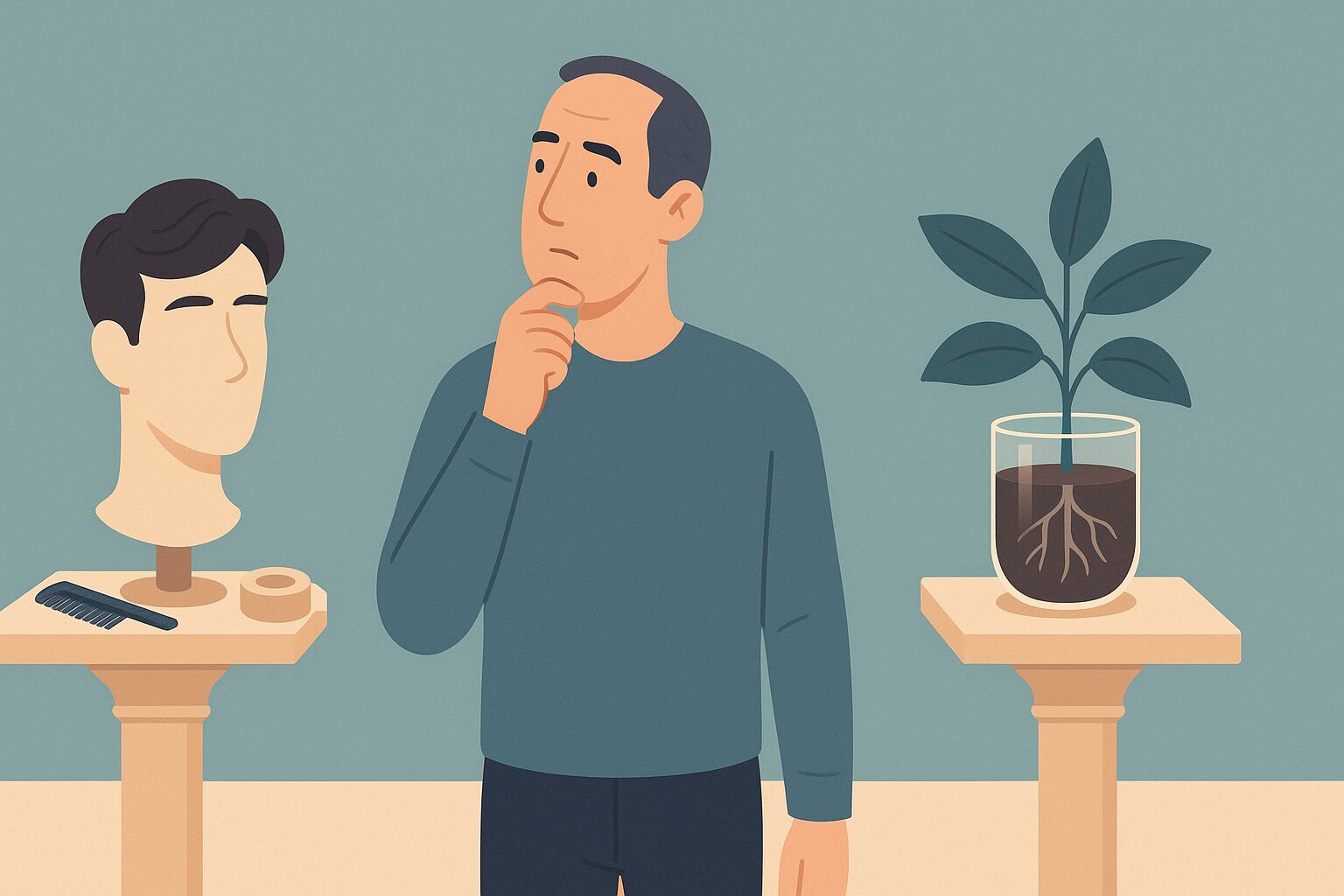
A hair system is a non-surgical hairpiece bonded to the scalp; a transplant moves your own follicles permanently. The system wins on instant, unlimited density. The transplant wins on zero maintenance — and over ten years, a well-kept system usually costs more than one transplant does.
The comparison most articles get wrong: a transplant cannot give a Norwood 6 the head of hair a system can. It was never supposed to.
Patients arrive at HairX Clinics having already tried something — concealer fibres, a topper, a full system, or nothing at all. The question they ask is usually framed as which one is better. It is the wrong frame. These are two different products solving two different problems, and the sensible choice depends almost entirely on how advanced the loss is and how much ongoing effort you are willing to sign up for.
What is a hair system, exactly?
A hair system is a thin base — polyurethane, lace, or a hybrid — knotted with human or synthetic hair and attached to the scalp with adhesive or tape. Modern ones are far better than the word wig suggests. The good ones have a see-through front edge, are cut and blended into your own remaining hair, and survive swimming and the gym.
They also come off. That is the whole design. Every two to six weeks the bond is dissolved, the scalp is cleaned, the base is reconditioned or replaced, and the system goes back on. Skipping that cycle is what causes the problems people associate with systems: trapped sebum, folliculitis, and adhesive irritation.
Which one gives better coverage?
The system, and it is not close at the advanced end. A system is manufactured to whatever density is ordered. A transplant is limited by a fixed, non-renewing supply of donor follicles — and once that supply is spent, it is spent.
| Stage of loss | What a transplant can realistically deliver | What a system delivers |
|---|---|---|
| Norwood 2–3 | Full, natural restoration of the hairline and temples | Overkill; usually unnecessary |
| Norwood 4 | Strong frontal restoration, thinner crown | Full coverage |
| Norwood 5 | Frontal framing; crown often deferred or declined | Full coverage |
| Norwood 6–7 | Partial framing at best; sometimes not advisable at all | Full coverage |
This is the honest part of the conversation that sales-led clinics skip. If you are far along the Norwood scale, no surgeon can move enough grafts to recreate the hair you had at twenty. Spreading a limited donor supply across a large bald area produces thin, see-through coverage that looks worse than a clean shave — and it consumes the donor area permanently.
What does each one demand of you?
This is where the accounts reverse.
- A system is a routine, permanently. Re-bonding every few weeks, specialist cleaning products, a replacement base every few months, and a relationship with whoever fits it. Travel, humidity and sweat all complicate it.
- A transplant is a project with an end date. Roughly two weeks of careful aftercare, a shedding phase, and then months of waiting. After the first year, transplanted hair is washed and cut like any other hair.
- Neither stops ongoing loss. A transplant does not protect the native hair around it, and a system hides loss rather than treating it. Medical maintenance, if it suits you, is a separate decision covered in our hair loss treatment guide.
What does each cost over ten years?
Single-figure comparisons mislead because one cost is a one-off and the other repeats. The structure matters more than the number.
| Transplant | Hair system | |
|---|---|---|
| Cost shape | One-off, occasionally twice in a lifetime | Recurring, indefinitely |
| Ongoing spend | Optional medication only | Replacement bases, adhesive, fitting appointments |
| If you stop paying | The hair stays | The hair goes, immediately |
| Egypt planning range, 2026 | EGP 35,000–100,000 per procedure | Varies widely by base quality and fitting frequency |
We publish the transplant range as a planning estimate, not a quote — the full breakdown of what moves it is in what a hair transplant in Egypt costs. System pricing we deliberately do not estimate, because it depends on a supplier relationship we have no part in. What we can say is that the recurring structure is the thing to model. Ten years of replacements and fittings adds up in a way a single procedure does not.
Can you switch from a system to a transplant?
Often, yes — but with two caveats worth knowing before you book anything.
- The donor area has to be assessed fresh. Years of adhesive and tension at the perimeter can affect the skin, and in rare cases the hair along the bond line. That perimeter is not always where a surgeon would have chosen to take from.
- Expectations have to be reset downward. Someone who has worn a dense system for five years has been looking at density no transplant will reproduce. Going straight from that to a surgical result is the single most common source of disappointment we see.
The reverse switch is easier. A system can be worn over a healed transplant, and some people use one to bridge the long wait while transplanted hair grows in. Do not bond anything to a freshly operated scalp — that decision belongs to the surgeon, not the fitter, and the timeline is set out in our recovery guide.
Find out what your donor area can actually support
We measure donor density and map the area of loss before discussing any procedure, and we say plainly when surgery is not the right answer. If a system suits your stage better, we will tell you that.
Which one fits your situation?
Strip away the marketing on both sides and the decision comes down to three honest answers.
| If this is true of you | Lean toward |
|---|---|
| Loss is confined to the hairline and temples | Transplant |
| Loss is extensive and you want full coverage now | System |
| You will not sustain a maintenance routine | Transplant |
| You need a result before a fixed date | System |
| You want the question closed permanently | Transplant, if donor supply allows |
| Your donor area has already been heavily harvested | System |
One more thing worth saying out loud: shaving down is a legitimate third option, and for a Norwood 6 with a modest donor area it is frequently the outcome people are happiest with a year later. A clinic that never raises it is selling, not advising.
Do hair systems damage the hair underneath?
A properly fitted and regularly serviced system should not. Problems arise from tension at the bond line and from leaving a system on too long between services, which can irritate the scalp and, over years, contribute to traction-related thinning at the perimeter.
Can anyone tell the difference in person?
Quality varies enormously. A well-made lace-front system, cut and blended by someone skilled, is difficult to spot. A cheap base with a blunt front edge is obvious. A transplant, once grown in, is your own hair and raises no question at all.
Is a transplant worth it if I am already Norwood 6?
Sometimes, for framing the face rather than full coverage, and only if donor density supports it. Any clinic promising full restoration at that stage is describing a result the donor supply cannot fund.
Will a transplant stop my hair loss?
No. Transplanted follicles are resistant to the hormonal process that caused the loss, but surrounding native hair continues on its own course. This is why planning assumes future loss rather than ignoring it.
Can I wear a system while waiting for a transplant to grow?
Many people do, but only after the scalp has fully healed and with the surgeon’s agreement on timing. Adhesive on a healing graft area risks the result you just paid for.
See your result before you book. A full year of it, from photos on your phone.
HairX shows you a twelve-month AI preview of your result and an estimated graft count before you speak to anyone. It is free and it takes minutes. The report covers your stage of hair loss, what your donor area can realistically give, and how the result comes in month by month, including the third month, when it looks worse before it gets better.