
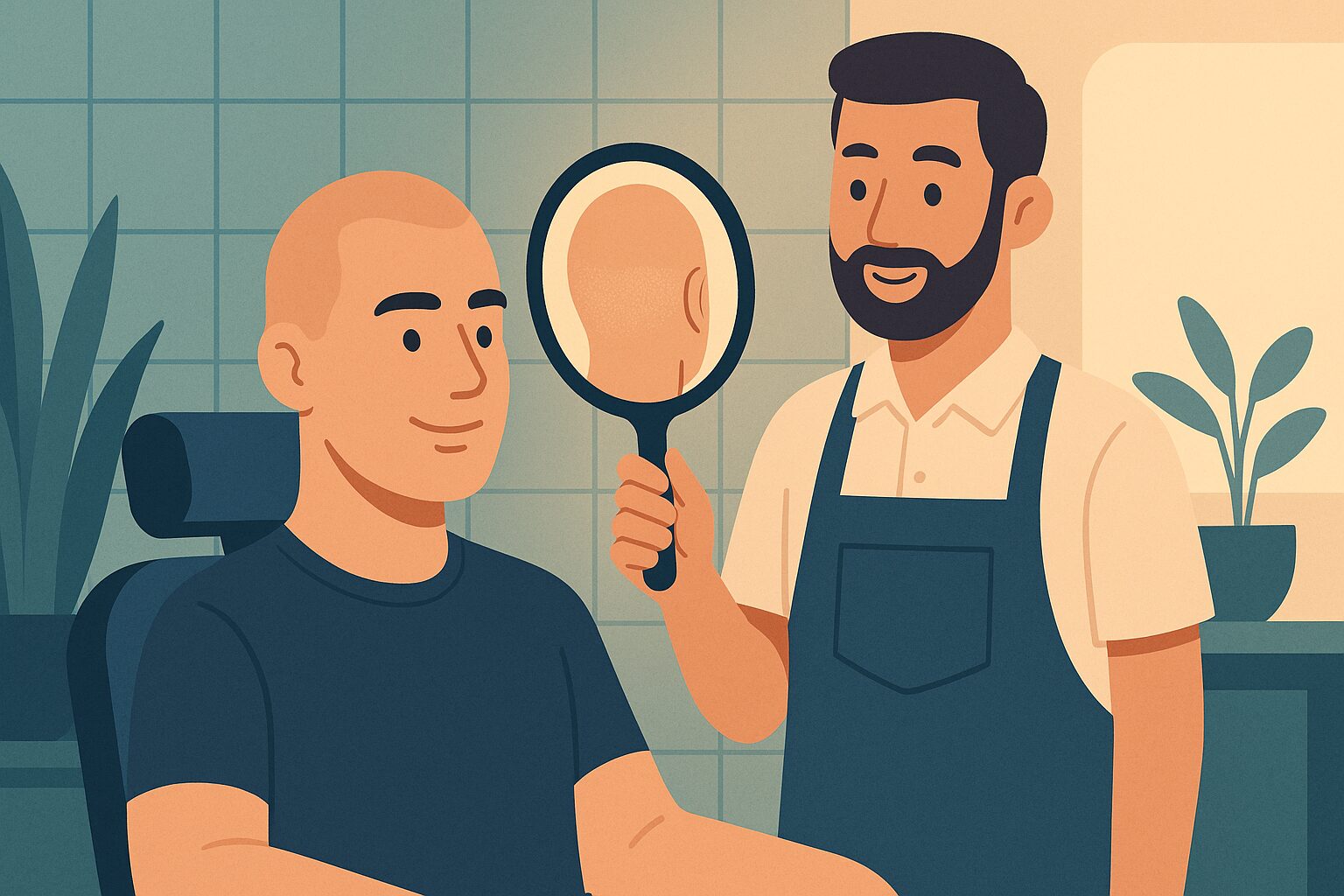
FUE is not scarless. It leaves hundreds of small round scars, typically under a millimetre each, spread across the donor area. Individually they are nearly invisible; that is what \u201cscarless\u201d marketing is built on.
But here is what patients are rarely told: when a donor area looks obviously operated on, scarring is usually not what you are seeing. You are seeing lost density from over-harvesting. People ask about scars and get reassured about the wrong problem.
This distinction decides which questions are worth asking before surgery. Scars are a cosmetic detail that resolves well in most people. Donor depletion is permanent and unfixable. At HairX Clinics the second is treated as the real risk, and this guide explains why.
What does FUE actually leave?
Each extraction removes a follicular unit with a circular punch, leaving an open wound that closes over within days. Over months it contracts into a small pale dot where no hair grows, because the follicle that grew there is now in your hairline.
Individually these are trivial. Collectively they are not, and that is the point most explanations skip: extracting two thousand grafts creates two thousand of them. Spread evenly across a wide, dense donor zone they disappear into the surrounding hair. Concentrated into a smaller area, they add up to visible patchiness.
| What you see | What it actually is | Fixable? |
|---|---|---|
| Faint dots at very short lengths | Normal FUE healing | Usually invisible at grade 2 and above |
| A patchy, moth-eaten donor area | Over-harvesting — lost density | No |
| White dots in a defined band | Concentrated extraction from one zone | Partially, with pigmentation |
| A fine horizontal line | Previous strip (FUT) surgery | Partially, with grafts or pigment |
| Raised or thickened scars | Individual healing tendency | Often, dermatologically |
| Pitting or ridging in the recipient area | Incision depth or graft placement error | Difficult |
Why is depletion the real problem?
Because nothing reverses it. Scars can be softened with pigment, camouflaged by hair length, or in the case of a strip line partially grafted into. A donor area that has had too many follicles removed has simply lost density, and there is no source to restore it from — the whole point of the donor area is that it was the source.
The practical consequences stack up. Short haircuts stop being an option. A second procedure may be impossible because no reserve remains. And it typically becomes obvious twelve to eighteen months after surgery, when the patient is long discharged and attention has moved to the front of the head.
What makes dot scars more visible?
Several things, most of them decided during surgery rather than by you.
- Punch size. Larger punches remove more surrounding tissue and leave larger marks.
- Extraction spacing. Punches placed too close together merge into a visibly thinned zone.
- Total load in one session. Very large sessions from a modest donor area concentrate the damage.
- Hair-to-scalp contrast. Dark hair on pale skin shows pale dots more than lower-contrast combinations.
- Individual healing. A minority scar more readily, which is worth raising if you know you do.
Only the last is about you. The first three are about surgical judgement and, frankly, about how many patients the clinic is processing that day.
Does the recipient area scar too?
Yes, though it almost never shows. Recipient incisions are much smaller than extraction punches and they heal with hair growing through them, which hides everything.
Problems there look different from scars. Pitting, where grafts sit slightly below the skin surface, or cobblestoning, where they sit slightly proud, both come from incision depth or placement rather than healing. They are uncommon in careful hands and difficult to correct afterwards, which is another argument for the surgeon making the sites personally. Normal healing of this area is set out in our day-by-day recovery guide.
Can existing scarring be improved?
Often, partially, depending on what it is. Scalp micropigmentation reduces contrast between pale scars and surrounding skin and is the most reliable option for dot scarring and strip lines alike. Grafting into a strip scar can break up the line, with the caveat that survival in scar tissue is lower than in normal scalp. Raised or thickened scars are a dermatological question rather than a surgical one.
Depletion is where the honesty has to be blunt: pigmentation can reduce how obvious a thinned donor area looks, but it does not add hair. Nothing does. Which is why the decision that matters was made before the first extraction, not after — the same arithmetic set out in our guide to how many grafts you need.
Can I shave my head after FUE?
Most people can at grade 2 or above without the dots being obvious. Grade zero is less predictable and depends on how evenly extraction was spread and on your hair-to-skin contrast.
How long until donor scars fade?
Wounds close within days, redness settles over weeks, and the marks mature over roughly a year. Judge the final appearance at twelve months, not at three.
Does DHI leave fewer scars?
No. DHI changes how grafts are placed, not how they are extracted. Donor scarring is identical because the extraction step is the same.
Will a second procedure double the scarring?
It adds more extraction points to a donor area that has already given some up. This is exactly why reserve has to be planned for in the first session rather than discovered missing in the second.
Can over-harvesting be repaired?
Not genuinely. Micropigmentation and hair length can make it less noticeable, and body hair is occasionally used in repair work, but lost density is not restored. Prevention is the only real answer.